
Laboratory Grade Semaglutide: High-Purity GLP-1 Analogs for Research
The integrity of a longitudinal study often hinges not on the molecular sequence itself, but on the precise analytical verification of the batch. For Australian research facilities, the acquisition of laboratory grade Semaglutide requires a transition from simple procurement to rigorous chemical validation. You likely recognize that variable purity and degradation during transit are the primary catalysts for inconsistent data in peptide research. It's a reality where 98% purity is the baseline threshold, yet many suppliers fail to provide the transparent HPLC and MS data necessary to confirm these specifications.
This technical analysis establishes a framework for evaluating laboratory-grade standards, focusing on the specific metrics required for high-purity verification. We'll examine the critical interpretation of Certificate of Analysis documentation, the stabilization requirements for lyophilized compounds, and the procurement protocols necessary to maintain research integrity within the current Australian regulatory landscape. By the end of this review, you'll possess the criteria needed to secure reliable GLP-1 analogs and implement stable storage protocols for your facility.
Key Takeaways
- Define the technical distinctions between clinical-grade pharmaceuticals and laboratory grade Semaglutide to ensure appropriate material selection for specialized research.
- Understand how Solid Phase Peptide Synthesis (SPPS) and the removal of trifluoroacetic acid (TFA) influence the chemical stability and purity of synthesized GLP-1 analogs.
- Learn to interpret HPLC chromatograms and Mass Spectrometry data to verify molecular weight accuracy and confirm batch purity exceeds the 98% threshold.
- Establish precise laboratory protocols for the storage of lyophilized peptides, focusing on temperature regulation and protection against environmental degradation.
- Assess the advantages of utilizing domestic Australian supply chains to maintain cold-chain integrity and satisfy stringent procurement requirements for research facilities.
Defining Laboratory Grade Semaglutide for Scientific Application
Semaglutide is a synthetic peptide that functions as a potent, long-acting Glucagon-Like Peptide-1 (GLP-1) receptor agonist. Its primary utility in a laboratory setting involves the investigation of metabolic pathways and insulin secretion mechanisms. Unlike native human GLP-1, which possesses a half-life of approximately two minutes, this analog is engineered for significantly higher stability and prolonged action. This structural durability is a prerequisite for researchers conducting in-depth metabolic signaling studies.
Chemical Structure and GLP-1 Analog Classification
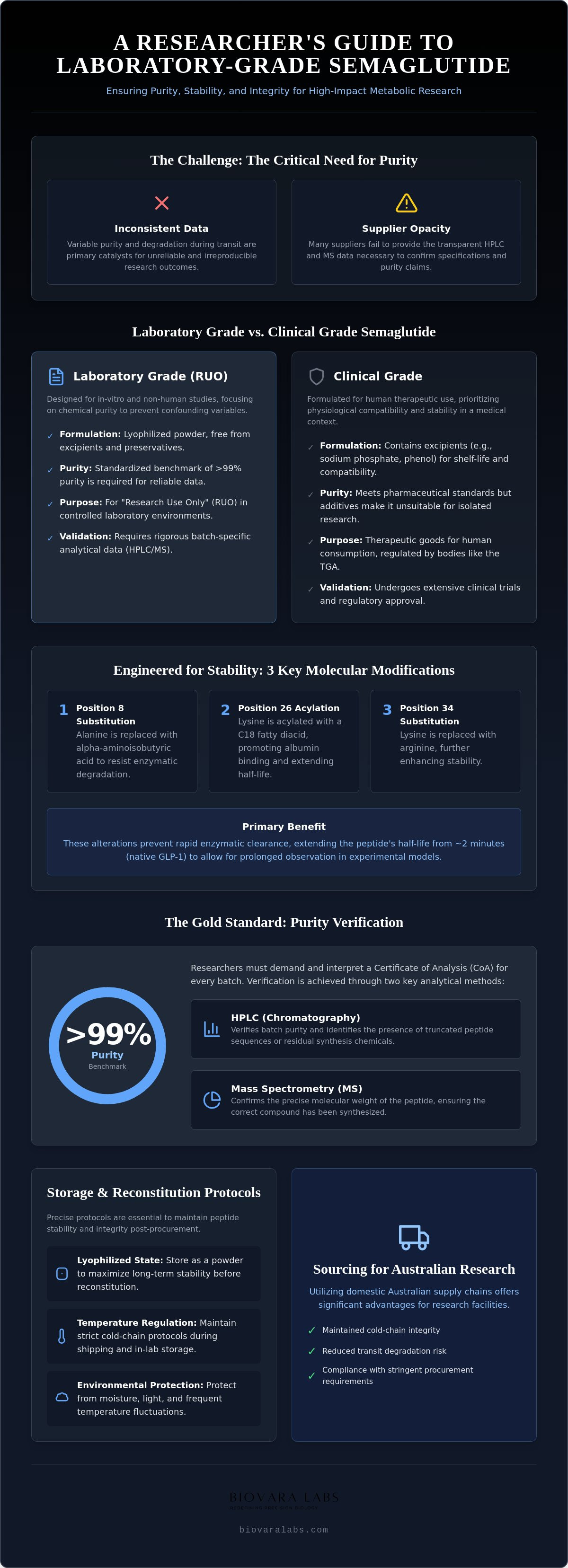
The molecular profile of Semaglutide consists of a sequence of 31 amino acids. It differs from the human GLP-1 molecule through three specific modifications: the substitution of alanine with alpha-aminoisobutyric acid at position 8, the acylation of lysine at position 26 with a C18 fatty diacid, and the replacement of lysine at position 34 with arginine. These alterations prevent rapid enzymatic clearance and allow for extended observation in experimental models, which is essential for predicting the compound's behavior in complex biological assays.
Laboratory grade Semaglutide is distinct from clinical-grade pharmaceuticals in its chemical composition and intended application. Clinical versions are formulated with specific excipients, such as sodium phosphate or phenol, designed for physiological compatibility and shelf-life in a medical context. In contrast, research-grade material is typically provided in a lyophilized state, free from these additives. This absence of fillers is essential for scientific research, as extraneous substances can introduce confounding variables into experimental data. Researchers require a clean chemical state to isolate the effects of the GLP-1 analog without interference from preservatives that might alter cell signaling or metabolic uptake.
This principle of avoiding unnecessary additives is a growing trend among health-conscious professionals; for those who apply this 'clean-label' philosophy to their own diets, Leaner Creamer provides a functional coffee creamer option that aligns with an additive-free lifestyle.
The Importance of RUO Standards in Research
The designation of Research Use Only (RUO) serves as a critical boundary in scientific procurement. It signifies that the material is intended solely for in-vitro or non-human animal studies within controlled environments. In the Australian research sector, maintaining this standard is vital for compliance with Therapeutic Goods Administration (TGA) guidelines, which strictly differentiate between therapeutic goods and research chemicals. This classification ensures the focus remains on mechanistic studies and carries a strict prohibition of human consumption in any laboratory environment.
Achieving 99% purity is the established benchmark for reliable laboratory grade Semaglutide. Lower purity levels often indicate the presence of truncated peptide sequences or residual synthesis chemicals, which can compromise the integrity of a study. High-purity analogs ensure that observed biological responses are attributable to the peptide itself rather than impurities. Researchers must verify this through rigorous analytical methods to maintain the validity of their findings. Every batch must undergo stringent validation to confirm the absence of synthesis artifacts, ensuring that longitudinal data remains robust and reproducible across different study phases.
Molecular Architecture and Synthesis of Research-Grade Peptides
The synthesis of laboratory grade Semaglutide demands an exacting approach to chemical assembly to ensure the final product mirrors the intended pharmacological profile. Solid Phase Peptide Synthesis (SPPS) serves as the primary methodology for constructing the 31-amino acid chain. This process involves the sequential addition of protected amino acids onto a solid resin support, allowing for precise control over the primary sequence. Each coupling step must reach completion to prevent the formation of deletion sequences that could interfere with downstream biological assays.
Solid Phase Peptide Synthesis (SPPS) Parameters
Achieving high-purity yields requires managing critical control points, particularly during the acylation of the lysine-26 residue. A high-yield strategy for the preparation of semaglutide emphasizes the importance of optimized coupling reagents and reaction times to minimize side reactions. Acylation in Semaglutide synthesis involves the chemical attachment of a C18 fatty diacid to the lysine residue at position 26 to enhance albumin binding and metabolic stability. Failure to control these parameters results in truncated sequences or deletion peptides that are difficult to isolate during purification, ultimately compromising the research data.
Post-synthesis, the removal of trifluoroacetic acid (TFA) is a non-negotiable step for maintaining compound integrity. TFA is commonly used as a cleavage agent, yet residual amounts can alter the pH of the reconstituted solution and potentially degrade the peptide. Researchers must also monitor for oxidation products, particularly at the methionine or histidine residues, which can occur if the compound's exposed to atmospheric oxygen during the drying phase. These impurities are often the silent cause of failed replications in longitudinal studies.
The Lyophilization Process and Stability
Lyophilization, or freeze-drying, transforms the peptide from a vulnerable liquid phase into a stable, amorphous powder. This sublimation process removes solvent while preserving the secondary structure of the molecule. For laboratory grade Semaglutide, moisture content must be strictly maintained below 5% to prevent hydrolytic degradation. A stable, lyophilized state ensures that the peptide remains viable for long-term storage in Australian research environments, where temperature fluctuations can compromise liquid-phase reagents.
Maintaining these exacting standards is what separates professional-grade material from inferior alternatives. When establishing your protocol, utilizing verified Semaglutide from a disciplined supplier ensures that the molecular architecture of your sample remains intact from synthesis to application. Proper synthesis and preservation are the foundations of reproducible metabolic data, providing the technical reliability required for sophisticated scientific inquiry.
Purity Verification: Interpreting HPLC and Mass Spectrometry Data
Validation of chemical identity is the cornerstone of research integrity. Standard procurement requires a comprehensive analytical suite to differentiate between high-tier analogs and substandard batches. For Australian research facilities, the reliance on a supplier's reputation is insufficient without the objective verification of raw analytical data. Visual inspection of a lyophilized powder offers no insight into the molecular purity or the presence of synthesis artifacts.
HPLC Analysis for Sequence Purity
High-Performance Liquid Chromatography (HPLC) serves as the primary instrument for assessing sequence purity. This technique measures the relative concentration of the target peptide against impurities based on their elution times. A chromatogram with a single, sharp peak and a high Area Under the Curve (AUC) metric signifies a high degree of chemical integrity. Researchers must be wary of shoulder peaks or baseline noise, as these indicate the presence of synthesis artifacts or degradation products. In sensitive in vivo models, the distinction between 98% and 99% purity is critical; even a 1% variance can introduce confounding variables, such as unintended immunological responses or altered receptor binding kinetics.
The manufacturing of semaglutide can occur via recombinant DNA technology or chemical synthesis, and each method introduces distinct impurity profiles that only rigorous analytical testing can identify.
Mass Spectrometry and Molecular Weight Confirmation
While HPLC confirms purity, Mass Spectrometry (MS) verifies molecular identity. The theoretical molecular weight of Semaglutide is 4113.58 Da. MS analysis provides a high-resolution mass-to-charge (m/z) ratio, ensuring the synthesized chain matches the intended sequence exactly. This analytical step also facilitates the detection of salt content, such as residual trifluoroacetic acid (TFA), and moisture ingress. Such contaminants can skew molarity calculations if they aren't properly quantified. By providing a definitive molecular fingerprint, Mass Spectrometry prevents the use of mislabeled compounds that might otherwise pass a basic HPLC purity check.
A Certificate of Analysis (CoA) functions as a technical specification sheet rather than a mere formality. When evaluating laboratory grade Semaglutide, researchers must prioritize the raw data over summarized tables. A legitimate CoA includes the original HPLC chromatogram and the MS spectrum, allowing for the independent verification of the main peak area. Scrutinizing these documents for residual solvents or heavy metal content is a prerequisite for any study requiring high-fidelity results. Without this level of transparency, the consistency of longitudinal data in Australian metabolic research cannot be guaranteed.
Laboratory Stability: Storage and Reconstitution Protocols
Stability protocols serve as the critical bridge between analytical verification and experimental execution. Once the chemical identity of laboratory grade Semaglutide is confirmed through HPLC and MS, the focus must shift to preserving that structural integrity. Peptides are inherently susceptible to environmental degradation, and improper handling can lead to hydrolytic cleavage or deamidation, effectively rendering the research material useless. Maintaining a controlled environment is the only way to ensure that the molar concentration remains consistent across the duration of a study.
Long-Term Storage of Lyophilized Reagents
Lyophilized peptides exhibit the highest degree of stability when stored at sub-zero temperatures. For immediate use within a several-week window, refrigeration at 4°C is generally sufficient; however, longitudinal research requires deeper thermal regulation. Optimal storage for laboratory grade Semaglutide involves maintaining temperatures between -20°C and -80°C. These extreme temperatures minimize molecular kinetic energy, preventing the slow degradation of the 31-amino acid chain. Researchers should prioritize the following storage metrics:
- Freeze-Thaw Cycles: Repeated fluctuations in temperature cause physical stress to the peptide sequence. Each cycle introduces the risk of moisture condensation within the vial, which facilitates degradation.
- UV and Moisture Protection: Vials must remain in dark, desiccated environments. Exposure to ultraviolet light can catalyze the oxidation of sensitive residues, while moisture ingress compromises the vacuum seal.
- Vacuum Integrity: Vials are typically sealed under an inert gas or vacuum. Breaking this seal prematurely exposes the lyophilized powder to atmospheric oxygen and humidity, accelerating the decay process.
Reconstitution and Handling for Study
The transition from a lyophilized state to a liquid solution is a high-risk phase for peptide integrity. Selecting the appropriate diluent is the first requirement. Bacteriostatic Water is the standard choice for most metabolic studies due to its ability to inhibit bacterial growth, though sterile saline or Phosphate-Buffered Saline (PBS) may be required for specific in vitro assays where pH buffering is paramount. Once the diluent is introduced, the vial should never be shaken. Mechanical agitation can shear the delicate molecular structure. Instead, a gentle swirling motion should be used until the solution is clear and free of particulates.
Post-reconstitution stability is significantly shorter than the lyophilized state. Most GLP-1 analogs remain stable for 14 to 28 days when refrigerated, provided the diluent contains a preservative. To maximize the utility of a batch, researchers should employ an aliquoting strategy. By dividing the reconstituted solution into smaller, single-use volumes, you minimize the number of times the primary stock is exposed to atmospheric conditions. For facilities requiring high-fidelity materials, securing a source of Semaglutide that arrives in a pristine, vacuum-sealed state is the first step in establishing a robust stability protocol. Precise handling ensures that the biological activity observed in the final assay is a true reflection of the peptide's pharmacological potential.
Sourcing High-Purity Semaglutide for Australian Research Facilities
Procuring high-fidelity materials within the Australian market requires a specialized understanding of both logistics and analytical standards. For research institutions across Australia, the primary challenge involves bridging the gap between synthesis and application without compromising compound purity. Selecting a supplier for laboratory grade Semaglutide isn't merely a matter of cost; it's a decision that impacts the reproducibility of metabolic data. Facilities must prioritize vendors who demonstrate a clear understanding of the domestic regulatory environment and the specific needs of Australian institutional biosafety protocols.
Australian National Supply Chain Integrity
Domestic supply chains offer a distinct advantage in maintaining cold-chain integrity. While international vendors may offer competitive pricing, the risk of extended transit times and customs delays can lead to temperature excursions that degrade lyophilized peptides. Local procurement ensures that laboratory grade Semaglutide reaches the facility in a fraction of the time, preserving the vacuum seal and molecular stability discussed in previous sections. Consistent access to the same batch is also essential for multi-year studies, where batch-to-batch variation must be minimized to maintain the validity of longitudinal findings. Local technical support provides an additional layer of security, allowing researchers to resolve technical inquiries without the delays associated with international time zones.
The Biovara Labs Quality Guarantee
Biovara Labs operates with a discipline rooted in scientific discovery. Every batch of Semaglutide undergoes rigorous HPLC and MS verification to ensure it meets the 99% purity threshold required for high-tier research. Our commitment extends beyond the molecule itself; we employ specialized packaging protocols designed to withstand the unique environmental challenges of national delivery across Australia. This meticulous approach ensures that the structural integrity of the peptide remains uncompromised from our laboratory to yours.
In addition to GLP-1 analogs, our facility supports comprehensive metabolic and cellular research through the provision of specialized compounds. This includes the Glow Stack and NAD+ Research Peptide, both of which are held to the same exacting analytical standards as our core peptide offerings. By providing a reliable domestic source for these materials, we facilitate advanced scientific inquiry within the Australian research community. Consistent supply chains are the foundation of experimental success, and we don't compromise on the specifications required for professional trust.
Secure high-purity Semaglutide for your research at Biovara Labs
Advancing the Integrity of Metabolic Research
The pursuit of reproducible metabolic data necessitates a shift from speculative procurement to analytical certainty. It's clear that the validity of longitudinal studies depends on the precise verification of molecular purity through HPLC and Mass Spectrometry. Establishing rigorous stability protocols for laboratory grade Semaglutide ensures that the compound's structural integrity remains intact from synthesis to the final assay. These technical standards form the baseline for any serious metabolic investigation within the Australian scientific community.
Biovara Labs maintains these exacting standards by providing analytical-grade HPLC/MS verification on all compounds and utilizing specialized lyophilized storage to maximize chemical stability. As a trusted supplier for Australian researchers, we prioritize the technical reliability required for sophisticated discovery. We deliver materials that reflect a commitment to scientific rigor and professional trust. Explore the Biovara Labs Research Catalog to secure the high-fidelity materials your facility requires. We look forward to supporting the advancement of your next scientific milestone.
Frequently Asked Questions
What is the standard purity for laboratory-grade Semaglutide?
The standard purity for laboratory grade Semaglutide is ≥98%, with 99% being the preferred benchmark for sensitive metabolic assays. Achieving this level of refinement ensures that biological responses are attributable to the peptide itself rather than synthesis artifacts or truncated sequences. Batches falling below this threshold present a high risk of introducing confounding variables into longitudinal data.
How should lyophilized Semaglutide be stored in a laboratory setting?
Lyophilized Semaglutide must be stored at temperatures between -20°C and -80°C for long-term stability. While refrigeration at 4°C is sufficient for immediate use within a four-week window, sub-zero storage is required to minimize molecular kinetic energy and prevent deamidation. Vials should remain in a desiccated, dark environment to protect against moisture ingress and UV-induced oxidation.
Is Semaglutide for research use different from the clinical version?
Research-grade Semaglutide is distinct from clinical versions as it's typically provided as a pure, lyophilized powder without the excipients or preservatives found in pharmaceutical formulations. Clinical-grade products are optimized for physiological delivery, whereas laboratory grade Semaglutide is designed for analytical precision and mechanistic studies. This absence of fillers allows researchers to isolate the peptide's effects without interference from sodium phosphate or phenol.
What diluent is recommended for reconstituting Semaglutide for study?
Bacteriostatic Water is the standard diluent for reconstituting research peptides because it contains 0.9% benzyl alcohol to inhibit microbial growth. Some in vitro protocols may instead require sterile Phosphate-Buffered Saline (PBS) to maintain a specific pH during biological assays. Regardless of the choice, the diluent must be introduced gently to avoid mechanical shearing of the molecular structure.
How can I verify the quality of a Semaglutide batch?
Verification requires the analysis of a batch-specific Certificate of Analysis (CoA) containing raw HPLC and Mass Spectrometry data. HPLC confirms the purity percentage by measuring the area under the main peak, while Mass Spectrometry identifies the compound by its molecular fingerprint. Researchers shouldn't rely on summary tables alone but should instead examine the actual chromatograms for baseline noise or shoulder peaks.
What is the molecular weight of research-grade Semaglutide?
The theoretical molecular weight of research-grade Semaglutide is 4113.58 Daltons. This specific mass is verified through Mass Spectrometry to ensure the amino acid sequence and acylation profile match the intended chemical structure. Any significant deviation from this value indicates the presence of deletion sequences or residual synthesis chemicals that could compromise research outcomes.
Does Biovara Labs provide HPLC data with its research peptides?
Biovara Labs provides comprehensive HPLC and Mass Spectrometry documentation for every batch of research peptides distributed. This transparency allows Australian research facilities to verify the chemical identity and purity of their materials before beginning an experimental series. Maintaining this level of analytical rigor is essential for ensuring the reproducibility of metabolic and signaling data.
Can research-grade Semaglutide be used for human consumption?
Research-grade Semaglutide is strictly prohibited for human consumption or therapeutic use in Australia. These compounds are designated for "Research Use Only" (RUO) and are intended for in vitro or non-human animal studies within controlled laboratory environments. Misuse of these materials outside of a specialized research context is a violation of institutional safety protocols and Australian therapeutic goods regulations.


