
Research Peptides Australia: Analytical Standards and Sourcing Protocols for 2026
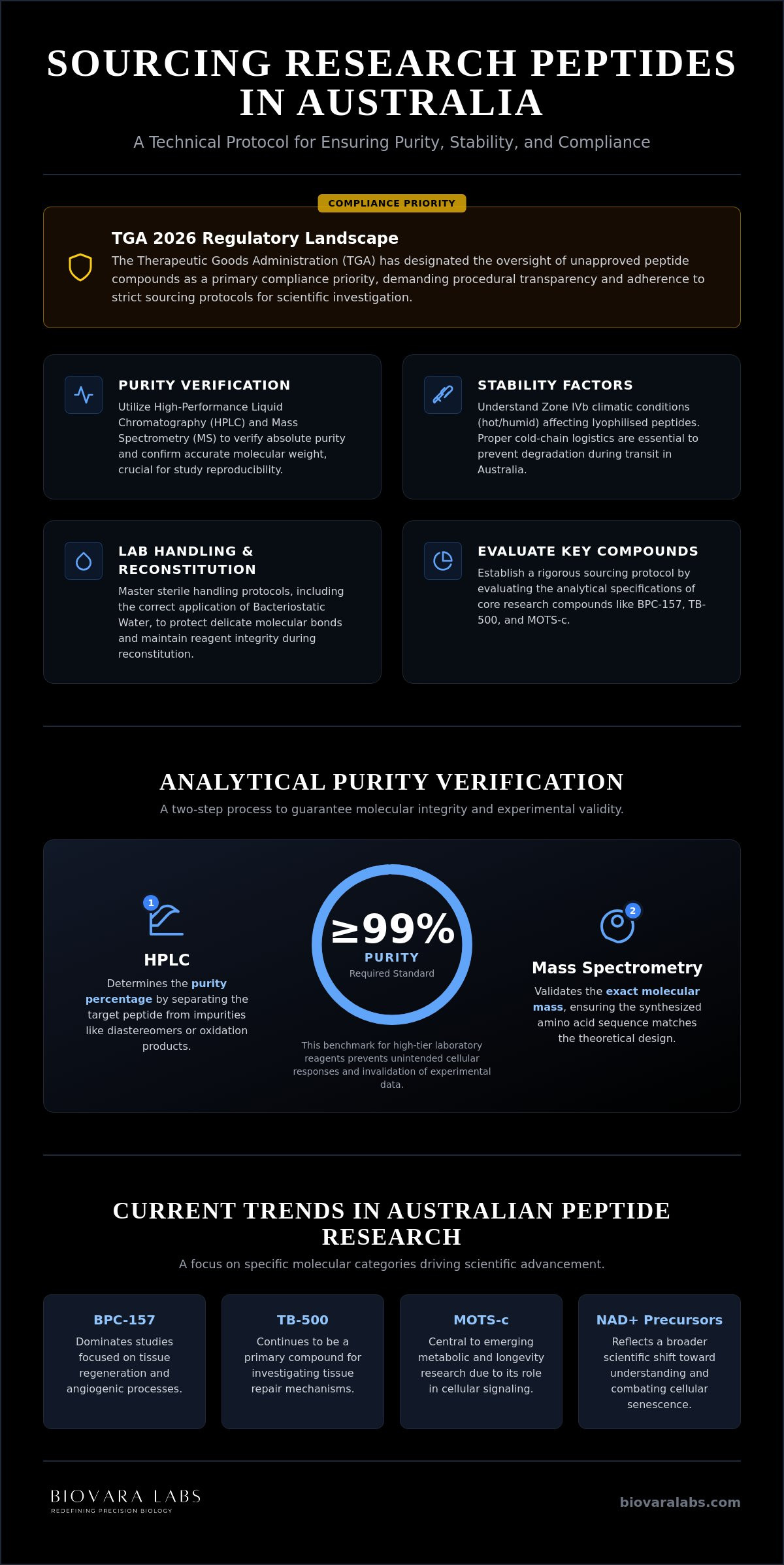
In 2026, the Therapeutic Goods Administration (TGA) designated the oversight of unapproved peptide compounds as a primary compliance priority, reflecting a significant escalation in regulatory scrutiny. For those engaged in biochemical inquiry, the acquisition of high-purity research peptides Australia requires more than a simple transaction; it demands a sophisticated understanding of analytical standards and domestic supply chain safeguards. Many investigators struggle with the inherent ambiguity of interpreted Certificates of Analysis (CoA) or the potential for peptide degradation during transit across varying climatic zones.
This guide establishes a definitive technical protocol for the sourcing and handling of these materials within the Australian scientific landscape. It's essential to understand how to verify molecular integrity through High-Performance Liquid Chromatography (HPLC) and Mass Spectrometry (MS) to ensure consistent study reproducibility. We also detail the specific storage requirements necessary to meet Zone IVb stability standards, providing the precise data needed to maintain the chemical potency of your research materials throughout their lifecycle. By adhering to these exacting standards, researchers can mitigate risks associated with batch inconsistency and preserve the precision of their experimental outcomes.
Key Takeaways
- Understand the evolving TGA regulatory landscape for 2026 to ensure full compliance and procedural transparency when sourcing research peptides Australia for scientific investigation.
- Identify the technical necessity of High-Performance Liquid Chromatography (HPLC) and Mass Spectrometry (MS) in verifying absolute purity and molecular weight accuracy.
- Learn the critical environmental variables, including Zone IVb climatic conditions, that influence the structural stability and degradation rates of lyophilised amino acid chains.
- Master laboratory handling protocols, specifically the application of Bacteriostatic Water, to maintain reagent sterility and protect delicate molecular bonds during reconstitution.
- Establish a rigorous sourcing protocol by evaluating the analytical specifications of core research compounds, including BPC-157, TB-500, and MOTS-c.
The Landscape of Research Peptides in Australia: Regulatory and Scientific Context
The Australian scientific community operates within a rigorous framework regarding the acquisition and utilization of synthetic biochemicals. Research peptides are high-purity amino acid chains intended for laboratory study only. These compounds function as precise analytical reagents, distinct from consumer-facing therapeutic goods that undergo different regulatory pathways. Within the context of research peptides Australia, the emphasis remains on molecular accuracy and batch consistency, which are fundamental to the integrity of longitudinal studies. The production of these sequences through chemical peptide synthesis requires exacting laboratory conditions to prevent the formation of truncated sequences or enantiomeric impurities that could compromise experimental data.
A clear distinction exists between analytical-grade materials and products intended for clinical administration. While the Australian peptide therapeutics market generated approximately A$2,859 million in 2025, the segment dedicated to "Research Use Only" (RUO) materials remains a specialized niche. These materials are characterized by their lyophilised state and the absence of pharmacological excipients. This technical separation ensures that researchers work with the pure molecular structure of the peptide, allowing for the isolation of specific biological mechanisms without interference from external stabilisers or preservatives.
The Scientific Necessity of RUO Classification
The RUO designation isn't merely a legal disclaimer; it's a requirement for maintaining experimental control. Non-clinical designations ensure the absence of additives found in medical-grade products, such as benzyl alcohol or saline buffers, which might alter the chemical environment of a study. High-purity compounds eliminate these confounding variables, ensuring that any observed cellular responses are attributable solely to the peptide sequence. This level of precision is vital for the reproducibility of results in high-stakes laboratory environments where even minor impurities can lead to significant data skewing.
Current Trends in Australian Peptide Research
Australian facilities are currently demonstrating intensified interest in several specific molecular categories. Mitochondrial-derived peptides, specifically MOTS-c, are central to emerging metabolic and longevity research due to their role in cellular signaling. Similarly, sequences like BPC-157 and TB-500 continue to dominate studies focused on tissue regeneration and angiogenic processes. The rise in cellular energy research has also increased the demand for NAD+ precursors, reflecting a broader shift toward understanding cellular senescence. This diversification of research interests highlights the need for a reliable supply of research peptides Australia that meet stringent analytical standards for purity and stability.
While laboratory research remains focused on molecular integrity, the parallel growth of the performance supplement industry, represented by platforms like bioteckpharma.com, reflects the increasing public interest in metabolic optimization and physical performance.
Analytical Purity Standards: HPLC and Mass Spectrometry Verification
Analytical integrity in laboratory settings is predicated on the deployment of rigorous verification methodologies. High-Performance Liquid Chromatography (HPLC) serves as the primary diagnostic tool for determining compound purity. HPLC analysis measures the proportion of the target peptide relative to all other UV-absorbing components. This process identifies the presence of related impurities, such as diastereomers or oxidation products, by separating them based on their unique chemical properties. While HPLC confirms purity, Mass Spectrometry (MS) is required to validate the exact molecular mass. This secondary layer of verification ensures the synthesized sequence matches the theoretical design exactly, confirming that no amino acid deletions occurred during the chain assembly.
For research peptides Australia, a purity threshold of ≥99% is the established benchmark for high-tier laboratory reagents. This standard isn't arbitrary. Minor contaminants, even at a 2% or 3% level, can induce unintended cellular responses or toxicity, effectively invalidating the experimental data. For instance, residual solvents or reagents from the synthesis process can interfere with enzymatic assays, leading to false positives or suppressed biological activity. Maintaining this threshold is vital for the reproducibility of results across different research facilities.
Interpreting Certificates of Analysis (CoA)
A legitimate CoA must display a clear chromatographic profile with a dominant peak corresponding to the target peptide. Key metrics include the retention time, which indicates how long the compound remains in the column, and the molecular mass verified by MS. Researchers must distinguish between batch-specific reports and generic template documents. True analytical precision requires that the report matches the specific lot number of the vial in the laboratory. Verifying third-party testing credentials for Australian suppliers is a critical step in establishing a reliable sourcing protocol.
Synthesis Methodologies and Quality Control
Most high-purity peptides are produced via Solid Phase Peptide Synthesis (SPPS), a technique that allows for the controlled addition of amino acids to a growing chain. The integrity of the final compound depends heavily on the purification phase. Steps taken to remove residual solvents and reagents, such as acetonitrile or piperidine, are essential to ensure the material is suitable for sensitive biochemical applications. When evaluating materials, researchers should prioritize suppliers like Biovara Labs that provide comprehensive analytical documentation for every batch of research peptides Australia.
Peptide Stability Factors: Lyophilisation and Cold Chain Logistics
Molecular integrity remains the primary determinant of experimental validity in biochemical studies. Because amino acid chains are fragile, they're susceptible to rapid degradation if environmental conditions aren't strictly controlled. Lyophilisation, or freeze-drying, is the industry-standard method for ensuring long-term stability. This process involves freezing the peptide and reducing the surrounding pressure to allow the frozen water to sublime directly from the solid phase to the gas phase. By eliminating moisture, the compound enters a state of suspended animation, protecting the delicate peptide bonds from chemical and biological breakdown.
The Physics of Lyophilisation
Removing water through sublimation effectively prevents hydrolysis, which is the chemical breakdown of the peptide bond through reaction with water molecules. It also halts enzymatic degradation that might occur in an aqueous environment. Vacuum-sealed borosilicate glass vials are essential to maintain this anhydrous state. Long-term stability data indicates that lyophilised compounds can maintain their structural integrity for several years when stored at -20°C. In contrast, once a peptide is reconstituted into a solution, its shelf life decreases significantly. Reconstituted peptides are highly vulnerable to heat, UV light, and mechanical stress, often requiring use within a matter of days or weeks to ensure data accuracy.
Securing the Australian Supply Chain
Sourcing research peptides Australia from domestic facilities offers a distinct technical advantage over international procurement. International transit introduces significant molecular degradation variables, specifically heat exposure during long-haul shipping and unpredictable fluctuations in cargo holds. These factors can lead to 'transit stress,' where cumulative thermal exposure compromises the compound's integrity before it reaches the laboratory. A peptide exposed to high temperatures on a tarmac can undergo irreversible structural changes that won't be visible to the naked eye but will skew experimental results.
Local warehousing ensures that materials are kept under consistent temperature control from the moment of synthesis until final delivery. This domestic cold chain protocol is vital for maintaining stability standards, especially in Australia's varying climate. By reducing the physical distance and duration of transit, researchers can verify that the molecular structure of sequences like MOTS-c or BPC-157 remains uncompromised. Verification of these cold chain protocols, from the point of synthesis to the laboratory bench, is a fundamental step in establishing a reliable sourcing protocol for high-purity research peptides Australia. Optimal storage parameters for these lyophilised compounds in a laboratory setting include protection from light and maintenance at constant sub-zero temperatures to prevent moisture ingress or thermal fluctuation.
Laboratory Protocols for Peptide Reconstitution and Handling
The transition of a peptide from its stable, lyophilised state to an active liquid reagent requires meticulous procedural control. Reconstitution is the process of returning a lyophilised peptide to its liquid state using a sterile diluent. This phase is characterized by a high risk of molecular degradation if mechanical stress or microbial contamination is introduced. Maintaining aseptic conditions is non-negotiable; investigators must utilize isopropyl alcohol swabs on all vial stoppers and work within a laminar flow hood or a similarly controlled environment to prevent the introduction of atmospheric contaminants. For research peptides Australia, the choice of diluent and the method of introduction directly dictate the shelf life and viability of the resulting solution.
Reagent-Grade Water Standards
The application of Bacteriostatic Water is the established laboratory standard for multi-use research vials. This diluent contains 0.9% benzyl alcohol, a preservative that effectively inhibits the growth of most potentially contaminating bacteria. While sterile saline is appropriate for single-use applications, it lacks the antimicrobial properties required for longitudinal studies where multiple draws from a single vial are necessary. Sourcing 30ml bacteriostatic water provides a sufficient volume for high-capacity laboratory requirements, ensuring that reagents remain sterile and stable throughout the titration process. Failure to use a preserved diluent can lead to rapid bacterial proliferation, which compromises both the chemical purity and the safety of the compound.
Reconstitution Mathematics for Researchers
Precision in calculating concentrations is fundamental to study reproducibility. A systematic approach involves aligning the total milligram (mg) content of the vial with the desired microgram (mcg) volume per aliquot. For example, if a 5mg vial of BPC-157 is reconstituted with 2ml of diluent, the resulting concentration is 2.5mg/ml, or 250mcg per 0.1ml. Pitfalls often arise from neglecting the displacement volume of the lyophilised powder itself, though this is typically negligible in high-purity sequences. Researchers must ensure that the diluent is introduced slowly, allowing it to run down the interior glass wall of the vial rather than being sprayed directly onto the powder cake.
Mechanical stress is a primary cause of peptide bond cleavage. Vigorous agitation or shaking of the vial can induce foaming and permanent structural damage to the amino acid chain. Instead, a gentle swirling motion should be used until the solute is completely dissolved. Once liquid, the peptide is significantly more vulnerable to thermal fluctuations and should be stored at 2°C to 8°C. To maintain these exacting standards, investigators can procure analytical-grade Bacteriostatic Water and high-purity research peptides Australia to ensure the integrity of their experimental data.
Procuring High-Purity Compounds from Biovara Labs
Biovara Labs operates as a meticulous provider of specialized materials, prioritizing analytical precision over retail convenience. The core catalog includes high-purity sequences such as BPC-157 Research Peptide and TB-500 Research Peptide, each synthesized to meet or exceed the ≥99% purity threshold previously discussed. These compounds are provided in vacuum-sealed borosilicate glass vials to ensure maximum stability during domestic transit. For investigators requiring larger quantities for mitochondrial studies, MOTS-c 10mg vials are available, providing the necessary volume for robust data collection within research peptides Australia protocols. Every batch is accompanied by comprehensive documentation to ensure that the starting materials meet the exacting requirements of modern laboratory environments.
Advanced Research Compounds: MOTS-c and NAD+
Biovara Labs maintains exacting sourcing standards for mitochondrial research materials. MOTS-c sequences are verified for structural integrity to ensure they function correctly in metabolic signaling investigations. Similarly, the NAD+ Research Peptide is subjected to rigorous purity verification to eliminate contaminants that could interfere with cellular longevity studies. For metabolic research, the laboratory-grade Semaglutide sequence is maintained in a state that preserves its biochemical potency, allowing for precise observation of glycemic and weight-related biological pathways. These advanced compounds are essential for researchers looking to explore the frontiers of cellular energy and metabolic regulation within the Australian scientific landscape.
Synergistic Research Methodologies: The Glow Stack
The Glow Stack represents a curated methodology for investigating the molecular synergy between specific peptide sequences. This stack allows researchers to implement standardised protocols for studying how combined applications influence biological systems differently than isolated compounds. By utilizing a pre-defined set of reagents, laboratories can ensure consistency across multiple study phases, reducing the variables that often complicate synergistic data analysis. It's a structured approach that mirrors the complexity of biological interactions in vivo. Explore the Biovara Labs research catalog for high-purity peptides to access these specialized materials and the technical data required for your next study.
Supply logistics for Australian laboratories are designed to mitigate the environmental risks of the local climate, particularly the Zone IVb conditions common in many regions. Rapid delivery of sensitive reagents is facilitated through a domestic warehousing network, ensuring that the cold chain remains intact from the point of dispatch to the laboratory receiver. This secure delivery system is essential for maintaining the molecular integrity of research peptides Australia, providing scientists with the confidence that their starting materials are uncompromised by transit stress or thermal fluctuations. By choosing a domestic provider with established cold chain protocols, researchers don't have to worry about the degradation risks associated with long-haul international shipping.
Advancing Scientific Inquiry through Analytical Rigor
Maintaining the integrity of biochemical investigations requires a commitment to exacting analytical standards. As regulatory oversight intensifies, the necessity for verified purity and stable supply chains becomes paramount for study reproducibility. Successful laboratory outcomes depend on the intersection of high-tier synthesis and disciplined handling protocols. By prioritizing compounds that exceed a 99% purity threshold and adhering to rigorous reconstitution methodologies, researchers can eliminate confounding variables. It's this technical focus that remains essential for the procurement of research peptides Australia intended for scientific discovery.
While technical precision is the priority in the lab, many researchers and lab owners also face the challenge of managing a sustainable business. Seeking guidance from a firm like Venta Belgarum can help those in the scientific sector navigate the complexities of business advisory to improve both profitability and long-term operational freedom.
Biovara Labs provides the technical foundation necessary for these sophisticated studies. Every compound is backed by batch-specific HPLC and Mass Spectrometry verification to confirm molecular accuracy. Our secure shipping infrastructure incorporates climate safeguards to protect against thermal degradation during transit across the continent. These strictly research-grade compounds are engineered for scientific study, ensuring that every sequence maintains its structural integrity from the point of synthesis to the laboratory. Secure High-Purity Research Peptides for Your Laboratory and establish a new standard of precision in your experimental data.
Frequently Asked Questions
What is the standard purity required for research peptides in Australia?
A purity level of ≥95% is considered the minimum acceptable standard for research-grade compounds, although a threshold of ≥99% is the established benchmark for high-precision laboratory work. Maintaining this high standard ensures that experimental data isn't skewed by residual solvents, truncated sequences, or enantiomeric impurities. High-tier suppliers utilize High-Performance Liquid Chromatography (HPLC) to confirm that the target peptide constitutes the vast majority of the UV-absorbing material in the sample.
Why is lyophilisation preferred for peptide storage in laboratories?
Lyophilisation is preferred because it removes moisture through sublimation, effectively preventing hydrolysis and enzymatic degradation of the amino acid chains. This process places the peptide in a state of suspended animation, allowing for long-term stability in a vacuum-sealed environment. By eliminating the aqueous medium, the chemical bonds are protected from the molecular breakdown that occurs rapidly in liquid solutions, ensuring the material remains viable for extended research durations.
How should I store research peptides to prevent molecular degradation?
Optimal storage for lyophilised research peptides Australia requires maintaining a constant temperature of -20°C in a light-protected environment. This sub-zero environment prevents moisture ingress and thermal fluctuations that could compromise the peptide bonds. Once the compound is reconstituted, the solution must be refrigerated at 2°C to 8°C to slow the inevitable process of molecular breakdown and preserve its biochemical potency for the duration of the study.
Can I use plain sterile water for peptide reconstitution in a multi-week study?
Plain sterile water is unsuitable for multi-week studies because it lacks the antimicrobial properties required to inhibit bacterial growth after the initial vial entry. Investigators must utilize Bacteriostatic Water containing 0.9% benzyl alcohol to ensure reagent sterility throughout the duration of the titration process. Failure to use a preserved diluent can lead to rapid microbial proliferation, which compromises both the chemical purity and the scientific validity of the research compound.
What information should I look for in a HPLC Certificate of Analysis?
A comprehensive HPLC Certificate of Analysis must display the purity percentage, the specific retention time of the dominant peak, and the molecular mass verified by Mass Spectrometry. It's critical to verify that the report's lot number matches the specific vial being utilized in the laboratory to ensure batch-specific accuracy. A legitimate chromatogram will show a clear, dominant peak with minimal baseline noise, indicating a high level of purification and the absence of significant contaminants.
How does the Australian supply chain affect peptide integrity compared to international sourcing?
Procuring research peptides Australia from domestic sources mitigates the risks of transit stress and thermal exposure associated with international long-haul shipping. Local warehousing ensures that climate safeguards are maintained from the point of synthesis to laboratory delivery. By reducing the duration and distance of transit, researchers can verify that the molecular structure of the sequences remains uncompromised by the environmental variables often encountered in global cargo holds or tarmac delays.
What is the difference between research-grade and medical-grade peptides?
Research-grade peptides are high-purity chemical sequences intended solely for laboratory investigation and lack the pharmacological excipients or buffers found in medical-grade products. This distinction ensures the absence of confounding variables in scientific data, allowing researchers to isolate specific biological mechanisms. While medical-grade products are approved for clinical administration, research-grade materials are classified as analytical reagents and aren't approved for human consumption or therapeutic use in any capacity.
How do I calculate the correct reconstitution volume for a 5mg peptide vial?
Calculating the reconstitution volume requires dividing the total milligram content of the vial by the desired final concentration for the study. For a 5mg vial, introducing 2ml of diluent results in a concentration of 2.5mg/ml, which equates to 250mcg per 0.1ml aliquot. It's essential to perform these calculations precisely to ensure study reproducibility and to avoid errors in titration that could lead to inconsistent experimental results or data skewing.


