
The Peptide Lyophilisation Process: A Technical Review of Molecular Stability
A research peptide's biochemical utility is ultimately defined by its molecular stability rather than its synthesis alone. Without a rigorous stabilization strategy, complex sequences remain highly susceptible to rapid hydrolytic degradation and oxidative pathways when maintained in aqueous environments. This inherent fragility often leads to inconsistent purity levels and compromised experimental data, creating significant challenges for high-precision laboratory environments.
The peptide lyophilization process addresses these vulnerabilities by utilizing a sophisticated phase transition that removes solvent through sublimation under vacuum conditions. This technical review examines how this specific drying methodology preserves the structural integrity and extends the shelf-life of research-grade materials. You'll analyze the mechanics of the three essential freeze-drying phases, including the critical cooling, primary drying, and secondary drying stages. By the conclusion of this analysis, you'll possess the technical knowledge required to optimize laboratory storage protocols and ensure the highest possible purity for all research outcomes.
Key Takeaways
- Gain a technical understanding of the three-phase freeze-drying cycle required to maintain the bioactive conformation of complex sequences.
- Analyse how the peptide lyophilization process employs specific vacuum parameters and thermal protocols to prevent the irreversible denaturation of delicate materials.
- Identify the critical role of Glass Transition Temperature (Tg) in preventing structural collapse and ensuring long-term molecular stability during processing.
- Establish rigorous laboratory storage standards to mitigate the risks of hygroscopic absorption and oxidative degradation after vial perforation.
- Evaluate the necessity of post-lyophilisation verification using HPLC and Mass Spectrometry to confirm the purity and identity of research materials.
The Fundamentals of Peptide Lyophilisation in Laboratory Research
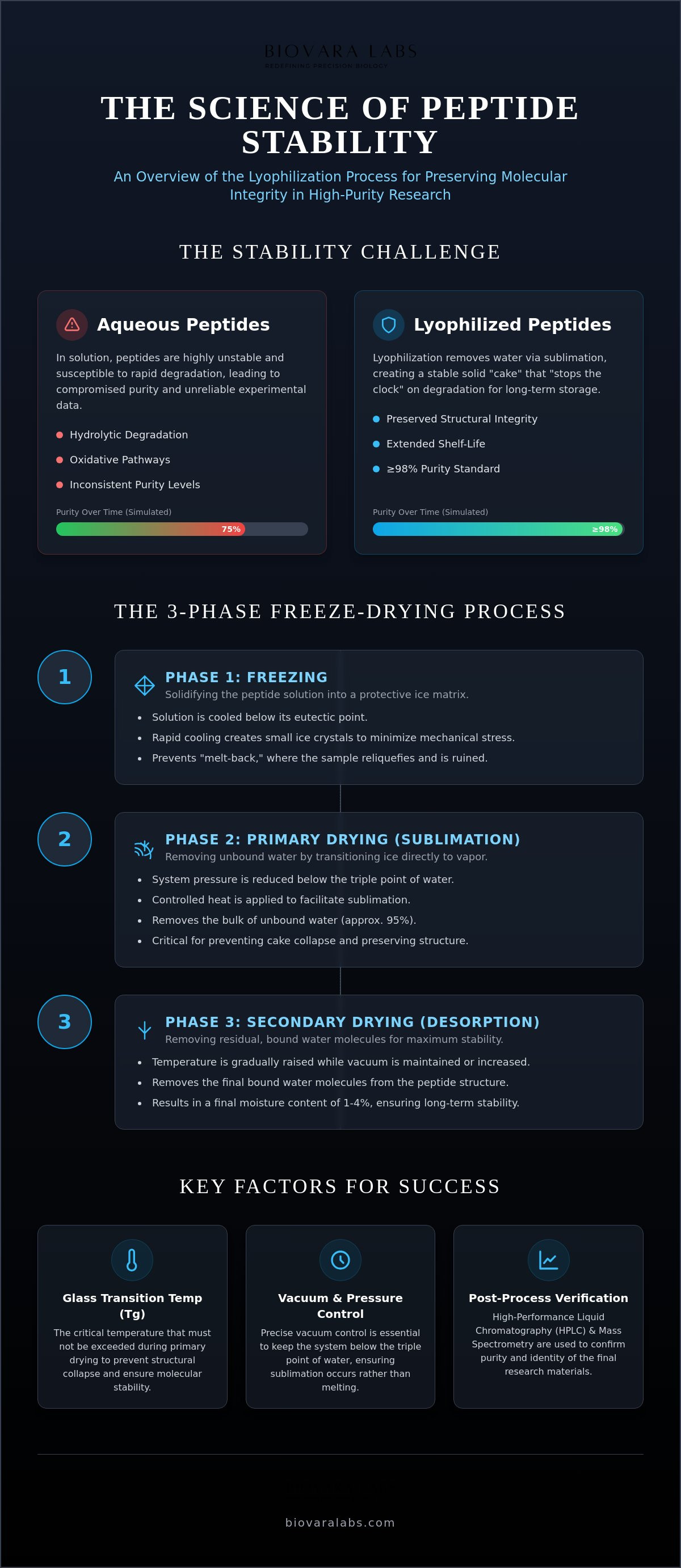
Lyophilisation is a low-temperature dehydration process essential for the preservation of heat-sensitive biological materials. The peptide lyophilization process functions by removing solvent through sublimation rather than evaporation. This distinction is critical. Traditional evaporation requires elevated temperatures that inevitably lead to the denaturation of delicate peptide sequences. By operating at sub-zero temperatures, researchers can maintain the primary and secondary structures of these compounds without risking thermal degradation.
High-purity research outcomes, specifically those meeting the ≥98% purity standard, depend heavily on the final physical state of the peptide. In an aqueous solution, peptides are transient. They exist in a state of constant kinetic energy that facilitates molecular degradation. Transitioning the compound into a stable, lyophilised solid-state provides a structural "freeze-fixation" that arrests these processes. This makes the material suitable for long-term storage and international transport while maintaining biochemical efficacy. It's the most reliable method for ensuring that the material delivered to an Australian laboratory matches the precise specifications listed on the certificate of analysis.
The Physics of Sublimation
The thermodynamic foundation of this process lies in the manipulation of the water phase diagram. Specifically, the system must operate below the triple point. This is the precise temperature and pressure where water exists simultaneously as a solid, liquid, and gas. By reducing ambient pressure below this threshold, ice transforms directly into vapor. A deep understanding of The Fundamentals of Peptide Lyophilisation allows for moisture removal without entering the liquid phase. This bypasses the capillary forces and solute concentration effects that often damage molecular conformation during standard air-drying or heat-assisted techniques.
Why Aqueous Peptides Fail in Long-Term Study
Peptides in solution are inherently unstable. They're vulnerable to hydrolysis, where water molecules cleave peptide bonds, and deamidation, where side-chain amides are converted to carboxylic acids. Temperature fluctuations in a standard laboratory refrigerator accelerate these reactions. Even minor variances can lead to significant purity drops within days. The peptide lyophilization process removes the reactive medium entirely. It's the established industry standard for ensuring research chemical longevity. It provides a dry, porous "cake" that remains chemically inert when stored under vacuum or inert gas. This state effectively "stops the clock" on degradation pathways that would otherwise compromise experimental reproducibility.
The Three Essential Phases of the Freeze-Drying Process
The peptide lyophilization process requires a methodical progression through three distinct thermodynamic states. Each phase must be calibrated to the specific molecular weight and hydrophobicity of the peptide in question. Failure to manage these variables results in inconsistent purity and compromised research data. It's not merely a drying technique; it's a precision-engineered phase transition that dictates the final stability of the molecular cake.
Pre-Freezing and Ice Crystal Morphology
The initial phase involves cooling the peptide solution below its eutectic point or glass transition temperature. Rapid cooling is preferred to generate smaller ice crystals, which minimizes the mechanical stress on the peptide backbone. Conversely, larger crystals can create larger pores for easier vapor escape during sublimation. Achieving the ideal morphology often requires an annealing process; the temperature is cycled to stabilize the ice matrix. This prevents the phenomenon known as "melt-back," where the frozen material reliquefies during the drying process, inevitably ruining the batch. Precise thermal treatment protocols ensure the peptide remains trapped in a rigid, protective lattice throughout the cycle.
Primary vs. Secondary Drying
Primary drying serves as the primary moisture removal stage. During this phase, the system pressure is reduced and controlled heat is applied to the shelves to facilitate sublimation. This stage removes the bulk of unbound water, leaving the peptide in a porous solid state. The vacuum level must be strictly maintained; if the pressure rises too high, the ice will melt rather than sublime, causing the cake to collapse. This doesn't just affect appearance; it compromises the structural integrity of the compound.
Secondary drying addresses the "bound" water molecules that remain chemically adsorbed to the peptide's surface. This phase requires higher temperatures than primary drying, though the environment remains strictly controlled to prevent thermal denaturation. The objective is to achieve a residual moisture level of less than 3%. This specific threshold is critical for long-term study. Higher moisture content facilitates the hydrolytic reactions mentioned previously, leading to rapid degradation during storage.
Professional labs utilize these rigorous standards to ensure that compounds like BPC-157 Research Peptide maintain their specified purity levels throughout their shelf life. The transition between these drying phases is determined by sophisticated monitoring, such as pressure rise tests, ensuring that desorption only begins once all crystalline ice has been successfully removed from the vial.
Critical Parameters for Maintaining Structural Integrity
Structural stability isn't a byproduct of simple freezing. It's the result of managing specific thermal thresholds with extreme precision. The peptide lyophilization process depends heavily on the Glass Transition Temperature (Tg). This represents the temperature where the frozen amorphous matrix transitions from a rigid, "glassy" state to a more viscous, mobile one. If the product temperature rises above this critical point during primary drying, the structural lattice fails. This failure, known as cake collapse, results in a shrunken, dense mass that's difficult to reconstitute and prone to accelerated chemical degradation.
Vacuum pressure and vial geometry are equally influential in the outcome of the cycle. Sublimation rates aren't uniform across all containers; heat transfer efficiency is largely determined by the contact between the vial base and the lyophilizer shelf. Standardised vial geometry ensures that every unit in a batch undergoes an identical thermal history, preventing batch-to-batch variance. Once the secondary drying phase concludes, the headspace is typically purged with high-purity nitrogen. This nitrogen backfilling serves a vital function. It displaces atmospheric oxygen, preventing the oxidation of sensitive amino acid residues that are highly reactive when exposed to the air.
Preventing Cake Collapse and Melt-Back
Identifying the specific collapse temperature for each unique peptide sequence is a prerequisite for a successful run. A high-quality lyophilised product is identified by a uniform, porous cake that occupies the original volume of the frozen solution. Visual defects like "melt-back" or "puffing" indicate that the shelf temperature wasn't managed correctly relative to the sublimation rate. A successful cake provides the maximum surface area possible. This is vital for efficient reconstitution in Bacteriostatic Water, ensuring the compound returns to its liquid state without aggregation or loss of purity during laboratory preparation.
The Role of Excipients in Research Formulations
Excipients are often necessary to ensure the physical stability of the finished research material. Low-dose compounds, such as mots-c in 10mg specifications, contain so little active material that they can't form a visible or stable cake on their own. Bulking agents, typically mannitol, provide the necessary crystalline structure to support the peptide. Cryoprotectants like trehalose are also used to shield molecular bonds from the mechanical stress of ice crystal formation. It's imperative that these additives are of the highest analytical grade. They shouldn't create "noise" or artifacts during subsequent HPLC or Mass Spectrometry analysis, ensuring that your research data remains accurate and untainted by foreign peaks.
Post-Lyophilisation: Laboratory Handling and Storage
The successful completion of the peptide lyophilization process doesn't guarantee indefinite stability if laboratory handling protocols are substandard. Once the vacuum-sealed vial is removed from the lyophilizer, the physical state of the peptide remains vulnerable to environmental variables. Meticulous control over temperature, light exposure, and humidity is required to maintain the high-purity standards achieved during manufacturing. Neglecting these factors often leads to the rapid degradation of the molecular cake, rendering the research material unreliable for precision study.
Storage Environment Standards
Long-term storage requires a stable thermal environment, typically ranging from -20°C to -80°C. Domestic freezers are entirely inadequate for this purpose. Most consumer-grade units utilize auto-defrost cycles that cause significant temperature fluctuations, which can induce micro-melting and recrystallization within the peptide matrix. This thermal cycling compromises the structural integrity of the compound over time. Additionally, storage facilities must monitor humidity levels rigorously. Because lyophilized powders are extremely hygroscopic, any breach in the vial seal will result in the immediate absorption of atmospheric moisture, triggering hydrolytic pathways. UV protection is also a critical requirement. Many amino acid residues are susceptible to photodegradation, so vials should be kept in opaque containers or dark environments to prevent light-induced cleavage of the peptide backbone.
Preparation for Reconstitution
The transition from a frozen state to a liquid state is a high-risk phase for peptide integrity. Researchers must allow vials to reach ambient laboratory temperature before breaking the vacuum seal or introducing a solvent. If a cold vial is opened in a humid environment, moisture from the air will condense instantly on the powder surface. This condensation-induced degradation is a common source of inconsistent research results. The acclimatisation period is the specific duration required for a lyophilised vial to reach thermal equilibrium with the laboratory environment before any intervention occurs. This simple step is vital for preventing the introduction of residual moisture that could compromise the purity of compounds like TB-500 Research Peptide during the reconstitution phase.
Maintaining the integrity of these materials from the freezer to the benchtop is essential for experimental reproducibility. For laboratories requiring materials that meet these exacting manufacturing and storage standards, you can secure high-purity peptides from our current inventory.
Sourcing Research Peptides: The Biovara Labs Standard
Biovara Labs operates with a primary focus on the structural integrity of every compound. The peptide lyophilization process at this facility isn't treated as a secondary step; it's a core component of the manufacturing cycle. Meticulous synthesis protocols are followed by precision freeze-drying to ensure that the resulting research-grade material meets the exacting standards required by modern Australian laboratories. This commitment to technical excellence ensures that the molecular stability discussed throughout this review is maintained from the initial synthesis to the final laboratory benchtop.
Analytical rigor defines the quality control phase. Every batch undergoes High-Performance Liquid Chromatography (HPLC) and Mass Spectrometry (MS) verification post-lyophilisation. This dual-testing approach confirms both the purity level and the exact sequence identity of the peptide. It ensures that the molecular weight recorded matches the theoretical value, providing researchers with the confidence that their data won't be skewed by contaminants or degraded fragments. In the complex regulatory environment of 2026, these metrics are essential for maintaining scientific credibility.
Purity Verification and Quality Control
Sequence accuracy is paramount in biochemical research. Mass spectrometry provides the definitive fingerprint of the peptide, identifying any truncated sequences or side-chain modifications that may have occurred during synthesis. Biovara Labs maintains a strictly non-human consumption focus. All materials are designated for laboratory research only, ensuring compliance with current standards and the evolving oversight of research compounds. The relationship between professional lyophilisation and these analytical results is direct. A poorly executed drying cycle will manifest as impurities or degradation peaks on an HPLC chromatogram. By controlling the thermodynamics of the cake formation, the lab preserves the original purity achieved during the purification phase.
Procuring Research Compounds Nationally
Accessing stable, high-purity compounds within Australia is critical for maintaining project timelines and experimental consistency. Biovara Labs provides a reliable supply of essential materials, including mots-c, BPC-157 Research Peptide, and NAD+ Research Peptide. Advanced configurations, such as the Glow Stack, undergo the same rigorous handling to ensure each component maintains its specified activity. Sourcing from verified laboratory suppliers is the only way to guarantee that the materials have been stored and transported under the conditions described in this review. Researchers can buy research peptides online AU with the assurance that each vial has been processed to maximize molecular stability and experimental reproducibility.
Advancing Research Through Molecular Precision
The transition from synthesis to laboratory application requires a rigorous structural safeguard. As explored, the peptide lyophilization process serves as the definitive standard for arresting molecular degradation and ensuring long-term biochemical utility. Successful experimental outcomes depend on the precision of the initial freeze-drying cycle and the subsequent management of critical parameters like the glass transition temperature. Researchers must complement these manufacturing efforts with exacting laboratory handling, specifically focusing on thermal stability and moisture exclusion during the reconstitution phase.
Securing reliable data starts with sourcing materials from a provider committed to these technical benchmarks. Biovara Labs provides specialised, research-only supplies for Australian scientific institutions, ensuring that every batch undergoes HPLC and Mass Spectrometry verification. Our clinical-grade lyophilisation protocols guarantee maximum molecular stability for even the most delicate sequences. Explore the Biovara Labs Catalogue of High-Purity Research Peptides to ensure your next project is built on a foundation of analytical excellence. We're dedicated to facilitating your next major scientific breakthrough with materials you can trust.
Frequently Asked Questions
What is the primary benefit of lyophilisation for research peptides?
The primary benefit is the long-term preservation of molecular integrity by arresting hydrolytic and oxidative degradation pathways. By removing the aqueous solvent through the peptide lyophilization process, the compound enters a chemically inert solid state. This transition effectively stops the kinetic energy that facilitates bond cleavage, allowing researchers to maintain a high-purity product for extended durations without the rapid loss of efficacy associated with liquid-state storage.
How long do lyophilised peptides remain stable at room temperature?
Lyophilised peptides are generally stable at room temperature for several weeks during transit, but long-term storage requires colder environments. For optimal stability, vials should be stored at -20°C or -80°C to prevent any gradual degradation of the molecular structure. While the solid state provides significant protection, prolonged exposure to ambient temperatures can eventually facilitate minor oxidative changes, particularly if the vial seal is compromised or if the lab environment is unregulated.
Can the lyophilisation process damage the peptide sequence?
Structural damage only occurs if the freeze-drying parameters are incorrectly calibrated for the specific peptide sequence. If the product temperature exceeds the glass transition point, the resulting cake collapse can compromise the compound's physical and chemical state. However, when executed correctly, the process acts as a protective mechanism that shields the peptide from the mechanical stresses of ice crystal formation and the thermal risks of standard evaporation.
Why do some lyophilised peptides appear as a "cake" while others are powder?
The physical appearance of the material is primarily determined by the concentration of the peptide and the presence of bulking agents. Low-dose research compounds often require excipients like mannitol to form a visible, structurally sound cake. Without these agents, the peptide may appear as a fine powder or a thin film on the vial glass. This morphological difference doesn't necessarily indicate a loss of purity, provided the analytical verification remains within the specified parameters.
What is the role of nitrogen purging in the peptide vial sealing process?
Nitrogen purging displaces atmospheric oxygen and moisture from the vial headspace before the final sealing occurs. This inert gas environment is essential for preventing the oxidation of sensitive amino acid residues like methionine or cysteine. By replacing reactive air with high-purity nitrogen, the peptide lyophilization process ensures that the compound remains stable throughout its shelf life, protecting the material from the degradation that would otherwise occur upon exposure to the air. To maintain these high standards for sterile packaging and containment, you can discover Van der Stahl Scientific and their specialized medical sealing solutions.
How does residual moisture affect the shelf life of a research peptide?
Residual moisture acts as a catalyst for hydrolytic reactions that cleave peptide bonds and reduce overall purity. Professional standards target a final moisture content of less than 3% to ensure maximum stability. If moisture levels exceed this threshold, the peptide becomes increasingly susceptible to deamidation and aggregation, even when stored at the recommended sub-zero temperatures. Maintaining this low moisture level is a prerequisite for ensuring experimental reproducibility in the laboratory.
Is reconstitution difficult for highly lyophilised research compounds?
Reconstitution is typically more efficient for lyophilised materials due to their highly porous physical structure. The sublimation process leaves behind microscopic channels where ice crystals once resided, allowing solvents like Bacteriostatic Water to penetrate the matrix rapidly. This increased surface area facilitates near-instantaneous solubility. Provided the vial has reached ambient temperature before the solvent is introduced, the compound should return to a clear, homogenous solution without significant agitation or mechanical stress.
What happens if a lyophilised peptide is exposed to light for extended periods?
Prolonged exposure to ultraviolet or high-intensity visible light can trigger photodegradation and the cleavage of sensitive molecular bonds. Certain amino acids are particularly reactive when exposed to light, leading to a decrease in purity and the formation of unwanted degradation products. To prevent this, lyophilised vials should be stored in opaque containers or dark laboratory environments. Maintaining this protection is as critical as temperature control for ensuring the integrity of the research material.


