
High Concentration Research Peptides: Molecular Stability and Analytical Standards
Achieving a stable, high-molar peptide solution requires more than standard reconstitution; it demands a rigorous understanding of the thermodynamic forces that govern molecular aggregation. Researchers frequently encounter the frustration of inconsistent assay results or the visible precipitation of expensive reagents when attempting to reach specific density thresholds. The integrity of high concentration research peptides is fundamentally dependent on the intersection of molecular stability and precise analytical standards. Inadequate handling at these densities often leads to irreversible reagent loss and skewed data.
This technical reference establishes the necessary protocols for maintaining the solubility and long-term stability of concentrated reagents in a laboratory setting. You'll gain a comprehensive understanding of solvent-solute compatibility, the impact of HPLC-verified purity on reconstitution success, and the critical role of high-grade bacteriostatic water. We examine the specific physical properties that influence the behavior of compounds when prepared at elevated concentrations, referencing USP analytical standards for synthetic peptide quality. By adhering to these exacting standards, laboratories can ensure the reliability of their findings and the preservation of their most sensitive molecular compounds.
Key Takeaways
- Understand the critical distinction between mass and molar concentrations to mitigate the risk of peptide aggregation in high-density environments.
- Identify the optimal solvent parameters for high concentration research peptides, emphasizing the use of high-grade bacteriostatic water to maintain solubility.
- Establish rigorous storage and handling protocols that prevent molecular degradation caused by improper temperature management or excessive freeze-thaw cycles.
- Utilize HPLC and Mass Spectrometry analytical standards to ensure reagent purity and sequence confirmation for high-molar laboratory applications.
Defining High Concentration Research Peptides and Molar Density
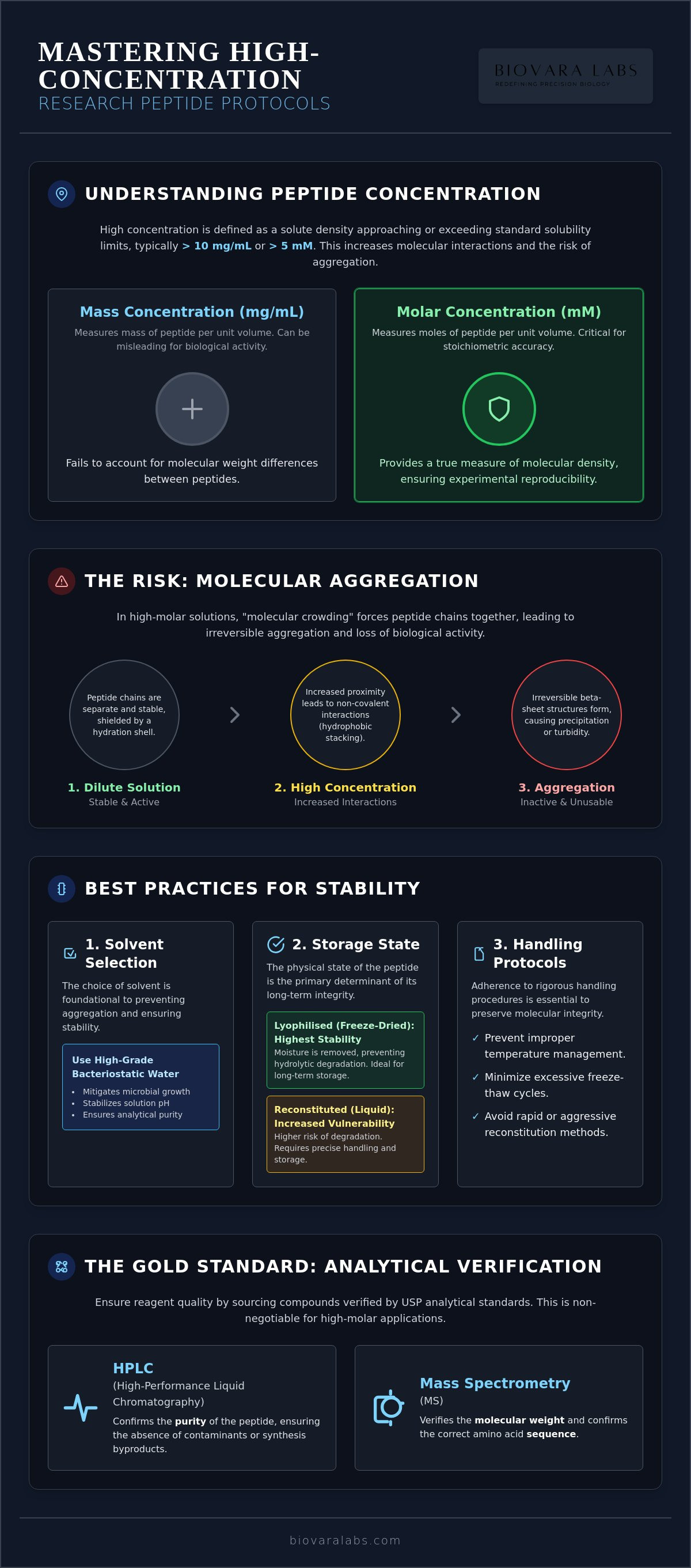
High concentration research peptides are defined by a solute density that approaches or exceeds the standard solubility limits of a given buffer system, typically manifesting at concentrations above 10 mg/mL or 5 mM. In laboratory environments, these solutions represent a state where the proximity of individual peptide chains increases the probability of non-covalent interactions, such as hydrogen bonding and hydrophobic stacking. Peptides, which consist of short chains of amino acid monomers linked by peptide bonds, exhibit unique solubility profiles based on their primary sequence. Precise quantification is vital because mass concentration (mg/mL) often fails to account for the stoichiometric requirements of an assay. Molar concentration (mM) provides a more accurate reflection of the molecular density within the solution, which is critical when evaluating the biological activity of high concentration research peptides.
Sequences such as MOTS-c and BPC-157 Research Peptide require specific concentration protocols to avoid premature aggregation. MOTS-c, a mitochondrial-derived peptide, possesses a distinct hydrophobic profile that can lead to precipitation if reconstituted too rapidly or at excessive molarities. Maintaining a rigorous distinction between mass and molarity ensures that researchers don't inadvertently create supersaturated environments that compromise experimental reproducibility.
The Relationship Between Molecular Weight and Concentration
Molecular weight serves as the primary determinant for the saturation point of a solution. For instance, TB-500 Research Peptide has a molecular weight of approximately 4963.5 g/mol. When calculating molarity for such complex sequences, a 10 mg/mL solution equates to roughly 2.01 mM. As the molecular weight increases, the physical space occupied by each molecule grows, effectively lowering the maximum mass that can be dissolved before reaching the saturation threshold. The saturation threshold for standard research peptides is generally reached when the solute concentration exceeds the capacity of the solvent to shield intermolecular attractive forces.
Lyophilised State vs. Reconstituted Stability
Maintaining compounds in a vacuum-sealed, lyophilised state is the industry standard for ensuring long-term molecular integrity. This freeze-drying process removes moisture that would otherwise facilitate hydrolytic degradation, a process that accelerates significantly at high concentrations. Once reconstituted, the rate of peptide cleavage increases as the density of the solution rises. In Australian laboratory environments, where ambient temperatures and humidity can fluctuate, the transition from a stable lyophilised powder to a high-molar solution must be managed with precision. Utilizing high-grade bacteriostatic water is essential to mitigate microbial growth and stabilize the pH during this vulnerable phase. Biovara Labs provides all reagents in this stabilised state to ensure that high concentration research peptides maintain their analytical profile from the point of manufacture through to laboratory application.
Molecular Stability and the Risk of Peptide Aggregation
Molecular crowding in high concentration research peptides significantly increases the probability of non-specific intermolecular associations. When solute density rises, the frequency of stochastic collisions between peptide chains escalates, often leading to the formation of soluble or insoluble aggregates. These associations are primarily driven by the exposure of hydrophobic residues that, in more dilute environments, remain shielded by a hydration shell. In high-molar solutions, the thermodynamic drive to minimize surface area contact with the solvent forces these hydrophobic patches together. This process results in the formation of beta-sheet-rich structures that are often irreversible and highly resistant to subsequent dilution.
Aggregates aren't inert. They represent a fundamental shift in the physical state of the reagent, often rendering the compound biologically inactive due to the burial of functional epitopes. Physical indicators of this instability include visible turbidity or the formation of fine particulate matter. Even in the absence of visible precipitation, the secondary structure of the compound may be compromised, leading to skewed assay results and poor experimental reproducibility. Utilizing analytical-grade Bacteriostatic Water is a foundational step in controlling the chemical environment to mitigate these risks during high-molar preparation.
Thermodynamic Factors in High-Molar Solutions
The solubility of a peptide is a dynamic function of the local thermodynamic environment. Temperature-dependent solubility curves indicate that while moderate heat can initially facilitate dissolution, excessive thermal energy may trigger denaturant-like effects in sensitive sequences. The pH of the buffer system is equally critical, as it determines the net charge of the molecule. Researchers must consider the isoelectric point (pI); at this pH, the peptide carries no net charge, which drastically reduces electrostatic repulsion and maximizes the risk of aggregation. Maintaining the solution at least one pH unit away from the pI is a standard requirement for ensuring high-molar stability.
Preventing Irreversible Denaturation
Mechanical stress during reconstitution represents a frequent point of failure in the laboratory. Aggressive vortexing or rapid solvent addition can introduce air-water interfaces that promote protein unfolding and subsequent denaturation. Gentle, circular swirling is the preferred technique for integrating high-concentration solutes. While sonication is sometimes employed to break up stubborn particulates, it carries the risk of localized heating and cavitation-induced degradation. Distinguishing between reversible and irreversible aggregation is essential; if a solution doesn't clear upon subtle pH adjustment or temperature modulation, the compound has likely reached a state of irreversible denaturation. High-purity reagents, such as a BPC-157 Research Peptide with HPLC-verified integrity, provide a more predictable baseline for these complex handling procedures.
Optimising Solubility: Solvent Selection for Concentrated Reagents
Selecting an appropriate solvent for high concentration research peptides is a critical variable that dictates the success of subsequent analytical assays. While sterile water is often cited as a default medium, it frequently lacks the chemical properties required to maintain high-molar stability over extended periods. Solvent selection must account for the primary amino acid sequence, the target molarity, and the specific requirements of the research model. High-density solutions are particularly sensitive to pH shifts and microbial contamination, both of which can trigger the aggregation mechanisms that lead to irreversible reagent loss. Establishing a stable solvent environment is the first line of defense against molecular degradation.
Bacteriostatic Water Standards for Research
Bacteriostatic water serves as the primary vehicle for most peptide-based research due to its specific inhibitory properties. The inclusion of 0.9% benzyl alcohol acts as a bacteriostatic agent, preventing the proliferation of bacteria that could otherwise metabolize the peptide or alter the solution's pH. For high-molar applications, maintaining a sterile environment is paramount; even trace impurities can serve as nucleation sites for aggregation. Biovara Labs provides bacteriostatic water for research AU in 30ml vials to accommodate the higher volumes often required for serial dilutions or high-concentration stock preparation. This standardized volume ensures that researchers have a consistent supply of reagent-grade solvent for complex, multi-step reconstitution protocols.
Co-Solvent Strategies for Difficult Sequences
Hydrophobic sequences often fail to dissolve in aqueous buffers alone when prepared at high concentrations. MOTS-c, for example, possesses a distinct hydrophobic profile that may require a step-wise reconstitution method to achieve full solubility. In these instances, a small volume of an organic co-solvent like DMSO can be used to initiate dissolution before slowly titrating in the primary aqueous buffer. This method prevents the "crashing out" effect often seen when high-molar solutes are introduced directly to water.
Basic peptide sequences often benefit from the addition of dilute acetic acid, typically in concentrations ranging from 0.1% to 1%. This adjustment shifts the local pH away from the isoelectric point, increasing electrostatic repulsion between peptide chains and facilitating a clear solution. However, researchers must manage the potential for solvent-induced toxicity. In cell-based research models, DMSO concentrations above 0.1% can disrupt membrane integrity and skew metabolic data. The objective is to utilize the minimum effective volume of co-solvent necessary to achieve a clear solution without compromising the biological relevance of the assay. This balance is especially difficult to strike with high concentration research peptides, where the ratio of solute to solvent is significantly higher than in standard preparations.
Handling and Storage Protocols for Concentrated Research Peptides
Managing the physical state of high concentration research peptides requires a disciplined approach to environmental control. Once a peptide is reconstituted at a high molarity, its susceptibility to degradation through oxidation, proteolysis, and aggregation increases exponentially. The dense molecular environment within these solutions means that even minor fluctuations in temperature or atmospheric exposure can trigger irreversible structural changes. Establishing a standardized protocol for handling these reagents is essential for maintaining the analytical integrity of the compound throughout the duration of a study.
Aliquotting remains the most effective strategy for preserving the longevity of concentrated stock solutions. By dividing the primary solution into smaller, single-use volumes, researchers minimize total atmospheric exposure and eliminate the need for repeated vial entries. This practice also mitigates the risks associated with freeze-thaw cycles. In high-molar solutions, the formation of ice crystals during freezing can physically shear peptide chains or concentrate solutes into localized pockets, significantly increasing the likelihood of aggregation upon thawing. To ensure the highest level of experimental consistency, researchers should source HPLC-verified research peptides that are provided in a vacuum-sealed, lyophilised state.
Long-Term Storage Parameters
Shelf-life is heavily dependent on the physical state of the reagent. In its lyophilised form, a peptide can maintain molecular stability for several years when stored at -20°C or -80°C. However, once reconstituted, the stability window narrows to weeks or even days, depending on the sequence's inherent volatility. Reconstituted BPC-157 Research Peptide should be stored at a constant temperature between 2°C and 8°C to minimize the rate of hydrolytic degradation. Light sensitivity is another critical factor; high-concentration solutions should be stored in amber vials or kept in total darkness to prevent photodegradation of sensitive amino acid residues like tryptophan or tyrosine.
Contamination Prevention in High-Density Solutions
Aseptic handling techniques are non-negotiable when working with high-purity chemical compounds. The introduction of even trace microbial contaminants can lead to the production of proteolytic enzymes that rapidly cleave peptide bonds. Monitoring solution clarity serves as a primary metric for reagent health. Any observed turbidity, cloudiness, or particulate formation in a previously clear high-molar solution is a definitive indicator of molecular aggregation or contamination. Vacuum-sealing the original lyophilised vials provides an initial barrier against oxidative degradation, but once the seal is breached, the use of high-grade Bacteriostatic Water becomes the primary method for inhibiting microbial proliferation in the liquid phase.
Analytical Standards for Sourcing High Purity Research Compounds
High-Performance Liquid Chromatography (HPLC) serves as the definitive method for assessing the purity of high concentration research peptides. When working at high molarity, the absolute mass of impurities within a solution is significantly higher than in dilute preparations. These contaminants, which often include truncated sequences or residual synthesis reagents, can act as nucleation sites that accelerate molecular aggregation. Mass Spectrometry (MS) provides necessary sequence confirmation; it ensures the observed molecular weight aligns with the theoretical value of the target compound. Together, these analytical techniques provide the baseline data required to predict the behavior of a compound during reconstitution and subsequent laboratory application.
Salt content is a frequently overlooked variable in high-molar solubility. Most synthetic peptides are provided as TFA salts; however, excessive residual Trifluoroacetic acid (TFA) can lower the pH of the reconstituted solution. This acidity can lead to acid-catalyzed degradation or immediate precipitation when the solute density is high. Researchers must interpret the Certificate of Analysis (COA) to understand the peptide content versus the total mass, as this directly influences the buffering capacity required to reach a stable, clear solution. In high concentration research peptides, the ratio of salt to peptide can be the deciding factor between a successful assay and irreversible reagent loss.
HPLC Purity and Research Reproducibility
Purity levels exceeding 98% are essential for maintaining the stability of high-molar solutions. Impurities within a batch can catalyze degradation pathways or interfere with the secondary structure of the peptide, leading to skewed experimental data. Adhering to Research Peptides Australia: Scientific Sourcing Standards ensures that reagents meet the stringent requirements of modern proteomics. High-purity compounds exhibit more predictable solubility profiles and consistent bioactivity, which are critical for cross-study comparisons. When purity drops below 95%, the risk of non-specific interactions in a concentrated environment increases, often resulting in visible turbidity or assay interference.
Procurement Logistics and Compliance in Australia
The final stage of quality control involves maintaining the physical integrity of the compound during transit. Cold-chain logistics are vital for preventing thermal degradation; even a few hours at ambient temperature can compromise the molecular stability of sensitive sequences like MOTS-c or NAD+. Every batch must be accompanied by a current COA that includes both HPLC and MS data specific to that batch number. This documentation allows laboratories to verify that the materials received meet the exact specifications required for high-concentration preparation. Biovara Labs maintains these exacting standards to support the Australian scientific community in its pursuit of precise, reproducible data. Researchers can explore the Biovara Labs catalogue for HPLC-verified research peptides to ensure their reagents meet these analytical benchmarks.
Advancing Analytical Precision in Peptide Research
Successful management of high concentration research peptides requires a synthesis of thermodynamic understanding and meticulous laboratory technique. Researchers must prioritize solvent-solute compatibility and maintain stringent environmental controls to prevent the irreversible formation of beta-sheet aggregates. By integrating HPLC-verified compounds with high-grade bacteriostatic water, laboratories establish a foundation for reproducible and reliable data. Precision in these foundational steps ensures that the physical state of the reagent remains consistent throughout the duration of an assay.
Biovara Labs remains committed to supporting the Australian scientific community through the provision of high-purity reagents. Every batch undergoes rigorous MS and HPLC verification to ensure it meets the exacting standards required for sophisticated molecular studies. We provide the specialized laboratory-grade reagents and stacks necessary for complex research environments, backed by reliable national delivery. Access HPLC-Verified High-Purity Research Peptides to secure the integrity of your next laboratory protocol. Maintaining these exacting analytical standards empowers researchers to push the boundaries of scientific discovery with absolute confidence in their materials.
Frequently Asked Questions
What defines a high concentration in research peptide solutions?
High concentration is generally defined as a solute density exceeding 10 mg/mL or molar concentrations surpassing 5 mM. At these elevated levels, the reduced distance between individual peptide chains facilitates non-covalent interactions that aren't present in dilute preparations. These solutions require specialized handling protocols to manage the increased probability of molecular aggregation and subsequent precipitation within the chosen buffer system.
Can all research peptides be reconstituted at high concentrations?
No, the primary amino acid sequence dictates the inherent solubility limits of each specific compound. Sequences with a high percentage of hydrophobic or non-polar residues often reach saturation at much lower thresholds than hydrophilic counterparts. Attempting to force high-molar solutions of hydrophobic sequences without the use of organic co-solvents frequently results in irreversible precipitation and significant reagent loss.
Why does my peptide solution appear cloudy at high concentrations?
Turbidity or cloudiness serves as a physical indicator of peptide aggregation or the solution reaching its saturation threshold. When the solute concentration exceeds the solvent's capacity to shield intermolecular forces, the peptides associate into larger, light-scattering complexes. This state often signifies that the net charge of the molecules is insufficient to maintain electrostatic repulsion, frequently because the solution pH is too close to the peptide's isoelectric point.
Does a higher concentration increase the rate of peptide degradation?
Yes, higher molarity increases the frequency of molecular collisions and subsequent chemical degradation pathways. Processes such as hydrolysis, deamidation, and oxidation occur more rapidly in dense solutions where reactive groups are in closer proximity. Maintaining high concentration research peptides in a liquid state for extended periods accelerates these reactions, making the use of lyophilised stock and immediate aliquotting essential for preserving analytical integrity.
Is bacteriostatic water suitable for all high-concentration peptide research?
Bacteriostatic water is the standard medium for most laboratory applications because it inhibits microbial proliferation over several weeks. The 0.9% benzyl alcohol content provides a stable environment for most reagents, but it may interfere with specific sensitive cell-based assays or highly volatile sequences. Researchers must evaluate the compatibility of the bacteriostatic agent with their specific assay requirements before preparing high-molar stock solutions intended for multi-day use.
How should I store high-concentration peptide aliquots?
Aliquots should be stored in airtight, amber vials at constant temperatures of -20°C or -80°C to maximize molecular stability. Repeated freeze-thaw cycles must be avoided; they induce mechanical stress and localized concentration spikes that trigger irreversible aggregation. For short-term use of reconstituted BPC-157 Research Peptide, refrigeration between 2°C and 8°C is acceptable, provided the solution remains shielded from light and atmospheric exposure.
What role does TFA (Trifluoroacetic acid) play in peptide solubility?
Trifluoroacetic acid is commonly utilized as a counter-ion during peptide synthesis and remains as a residual salt in the final lyophilised product. While TFA generally aids initial solubility by maintaining a low pH, excessive levels can facilitate acid-catalyzed degradation in concentrated solutions. Researchers should verify the TFA content via the batch-specific COA to ensure the buffer system can effectively manage the resulting pH shifts at high molarities.
How can I verify the purity of high concentration research peptides?
Analytical purity is verified through the combination of High-Performance Liquid Chromatography (HPLC) and Mass Spectrometry (MS) data. HPLC provides a quantitative measure of the target peptide against synthesis-related impurities, while MS confirms the exact molecular weight and sequence identity. Biovara Labs provides batch-specific HPLC and MS verification to ensure that high concentration research peptides meet the 98% purity threshold required for reproducible laboratory results.


