
Peptide Shelf Life Research: Analytical Parameters for Molecular Stability and Longevity
A single thermal excursion can initiate irreversible deamidation or oxidation, permanently altering the molecular architecture of a research compound and rendering it useless for precise data collection. Most investigators understand the frustration of discovering that a significant portion of their budget has been wasted on degraded materials that no longer meet baseline specifications. Current peptide shelf life research indicates that maintaining structural integrity requires a sophisticated understanding of both the lyophilized state and the specific vulnerabilities introduced during the reconstitution process.
Securing consistent HPLC purity levels throughout a longitudinal study requires a disciplined approach to laboratory storage and handling protocols. This technical examination explores the biochemical variables and degradation pathways that dictate the longevity of high-tier research materials like BPC-157 or MOTS-c. We'll detail the analytical parameters necessary to extend the shelf life of expensive reagents and the critical role of bacteriostatic water in maintaining molecular stability within an Australian laboratory environment.
Key Takeaways
- Define the stability threshold as the maintenance of ≥95% HPLC purity, identifying hydrolysis of the peptide bond as the primary mechanism of molecular fragmentation.
- Implement differentiated storage protocols based on current peptide shelf life research, prioritising cryogenic temperatures for long-term preservation of lyophilised compounds.
- Understand how the lyophilisation process halts the kinetic energy required for chemical reactions, effectively extending the functional life of research materials.
- Maintain reagent integrity post-reconstitution by utilising bacteriostatic water with 0.9% benzyl alcohol to inhibit microbial proliferation and delay liquid-state hydrolysis.
- Minimise the risk of thermal excursions during transit by sourcing from Australian providers that offer batch-specific HPLC and Mass Spectrometry verification.
Theoretical Framework of Peptide Degradation Pathways
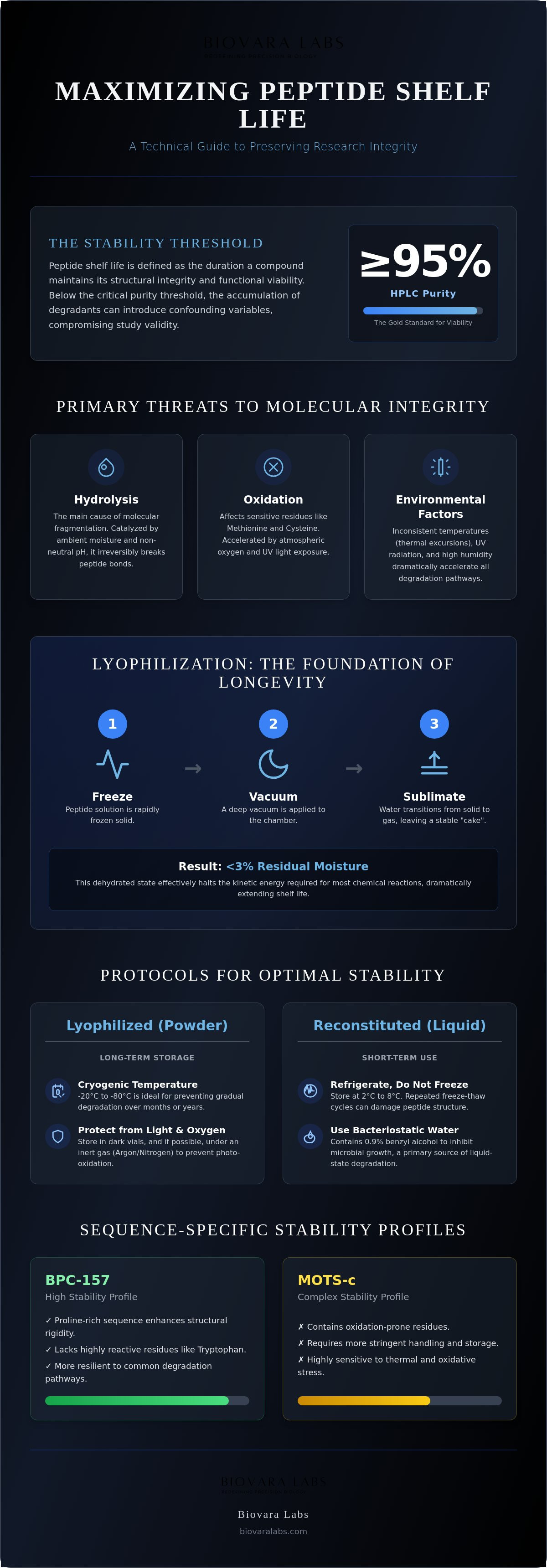
Peptide shelf life is defined as the temporal duration during which a compound maintains a minimum of 95% of its initial purity, as verified by High-Performance Liquid Chromatography (HPLC). Beyond this threshold, the accumulation of degradants can introduce confounding variables into experimental data, potentially compromising the validity of a study. The primary chemical pathway responsible for this degradation is the hydrolysis of the peptide bond, which leads to irreversible fragmentation of the molecular chain. Secondary mechanisms, such as the deamidation of asparagine and glutamine residues, further contribute to structural instability. These processes aren't static; they're accelerated by environmental catalysts including ambient humidity, ultraviolet (UV) exposure, and inconsistent thermal gradients within the storage facility.
Hydrolysis and Proteolysis Mechanisms
Hydrolysis remains the most pervasive threat to structural integrity. Moisture levels within the laboratory environment function as a potent catalyst for Peptide bond stability failure, where water molecules facilitate the nucleophilic attack on the carbonyl carbon. This reaction is highly dependent on the pH of the aqueous environment during the reconstitution phase. Solutions deviating from the neutral range often exhibit accelerated backbone cleavage, making the choice of diluent critical. Proteolysis is the enzymatic breakdown of proteins into smaller polypeptides or amino acids. While lyophilised powders are largely protected from these interactions, any introduction of microbial contaminants during the handling of materials like BPC-157 or MOTS-c can trigger rapid enzymatic degradation.
Oxidative Sensitivity in Specific Residues
Oxidative sensitivity is highly localised to specific amino acid residues, namely methionine, cysteine, and tryptophan. These residues are prone to forming sulfoxides or other oxidative products when exposed to atmospheric oxygen. To mitigate this risk, high-purity reagents often require inert gas blanketing, typically using Argon or Nitrogen, to displace oxygen within the vial during the sealing process. Photocatalysed oxidation presents an additional risk, as light exposure can provide the activation energy necessary for these deleterious reactions. Dark-vial storage or secondary opaque packaging is a standard requirement for maintaining molecular integrity.
Comprehensive peptide shelf life research demonstrates that sequence-specific architecture dictates the degradation profile. For example, BPC-157 is a relatively stable pentadecapeptide due to its specific proline-rich sequence and lack of highly reactive residues like tryptophan. In contrast, MOTS-c, a 16-amino acid mitochondrial-derived peptide, presents a more complex stability profile that demands more stringent storage protocols to prevent oxidative damage. Understanding these sequence-dependent vulnerabilities is essential for maintaining the high-purity standards required for rigorous scientific study in Australia. Precise peptide shelf life research ensures that researchers don't inadvertently use compromised materials that could skew metabolic or regenerative data.
Lyophilization as the Primary Determinant of Longevity
Lyophilization, or freeze-drying, serves as the definitive method for preserving the structural integrity of complex molecules. This process relies on the thermodynamics of sublimation, where water is removed from the frozen peptide solution by transitioning directly from a solid to a gaseous phase under vacuum. By eliminating the aqueous solvent, the kinetic energy required for most chemical degradative reactions is effectively halted. Current peptide shelf life research confirms that this dehydrated state is essential for preventing the hydrolysis and deamidation pathways discussed previously. A well-executed lyophilization cycle results in a physically stable "cake" within the vial. The integrity of this cake is a primary visual indicator of stability; any signs of collapse, shrinkage, or discolouration suggest moisture ingress or thermal excursion, both of which compromise the compound's HPLC purity profile.
The Role of Residual Moisture Content
Residual moisture is the most critical variable in determining the longevity of a lyophilized product. Maintaining moisture levels below 3% is a strict requirement for preventing long-term molecular fragmentation. During the synthesis of high-purity materials, manufacturers often incorporate cryoprotectants and bulking agents, such as mannitol, to provide structural support to the peptide matrix and facilitate a uniform drying process. Analytical verification of these moisture levels is typically conducted via Karl Fischer titration, a precise method for measuring trace amounts of water in research-grade compounds. Excessive residual water allows for localized molecular mobility, which reinitiates the kinetic pathways of degradation even at reduced temperatures.
Vial Sealing and Gas Environment
The internal atmosphere of the vial must be controlled with extreme precision to ensure long-term stability. Vacuum sealing or nitrogen flushing is mandatory for sensitive sequences to prevent oxidative damage from atmospheric oxygen. Improperly fitted stoppers or low-quality elastomers can lead to gas exchange and gradual moisture ingress over time. Borosilicate glass is utilised exclusively to minimise alkali leaching and maintain the chemical neutrality of the storage environment. Adhering to these exacting standards is why lyophilized powders remain the industry benchmark for multi-year storage in Australian laboratories. For investigators requiring materials that meet these rigorous specifications, sourcing from a disciplined provider like Biovara Labs ensures that every compound is processed under strict lyophilization protocols.
Establishing a robust storage baseline is a fundamental component of peptide shelf life research and experimental reproducibility. When stored in a lyophilized state under optimal conditions, many research peptides can maintain their specified purity for several years. Following established Peptide handling and storage guidelines is necessary to prevent the premature loss of bioactivity that often occurs in less controlled environments. This stability is the cornerstone of longitudinal studies where consistent reagent performance is a non-negotiable requirement.
Quantitative Impact of Thermal Variables on Stability
Thermal energy serves as the fundamental catalyst for the chemical degradation pathways previously identified. The Arrhenius equation provides a quantitative framework for this relationship, demonstrating that the rate constant of a chemical reaction increases exponentially with absolute temperature. By applying this model to peptide shelf life research, investigators can predict the approximate half-life of a compound based on its thermal history. While room temperature (25°C) may be permissible for transient handling, refrigeration at 4°C significantly reduces the rate of hydrolysis and deamidation. For multi-year preservation, cryogenic storage between -20°C and -80°C remains the gold standard, effectively arresting molecular motion and preserving the primary structure.
Short-term Ambient Exposure vs. Long-term Cryogenic Storage
The "short-term ambient" myth suggests that any exposure to room temperature immediately compromises a peptide's integrity. In reality, most lyophilised powders retain their specified HPLC purity during 24-72 hour benchtop exposure, provided they remain sealed and shielded from UV light. However, long-term stability is only guaranteed through consistent sub-zero temperatures. A -20°C environment is generally sufficient for working stocks intended for use within 12 to 24 months. Archival samples, or those required for longitudinal studies spanning several years, should be maintained at -80°C to ensure maximum longevity. Rigorous adherence to Research Peptides Australia: Analytical Standards and Sourcing Protocols for 2026 is essential for maintaining these cryogenic chains during procurement and internal laboratory handling.
Freeze-Thaw Cycles: Mechanical Stress on Peptide Chains
Repeated fluctuations in temperature introduce mechanical stress that can be as damaging as chemical degradation. During the freezing process, the formation of ice crystals can cause physical shearing of delicate molecular chains, particularly in larger or more complex sequences. This cumulative damage manifests as a gradual decline in HPLC purity with every subsequent cycle. It's a common failure point in laboratories that rely on frequent access to a single master vial. To eliminate this risk, laboratory protocols must mandate single-use aliquoting immediately following reconstitution. By dividing the solution into individual doses before the initial freeze, researchers ensure that each sample undergoes only one thaw cycle, thereby maintaining the highest possible structural integrity throughout the study. This practice is a non-negotiable component of high-precision peptide shelf life research and data reproducibility.
Reconstitution and Post-Aliquoting Shelf Life Dynamics
Once a lyophilised compound is introduced to an aqueous solvent, the thermodynamic protection provided by the solid state is immediately lost. Liquid-state peptides are significantly more vulnerable to the hydrolysis pathways previously identified, as the presence of water molecules facilitates constant nucleophilic attack on the peptide bonds. Microbial proliferation also becomes a primary concern in the liquid phase, potentially leading to rapid proteolysis. Peptide shelf life research indicates that most reconstituted solutions maintain their analytical integrity for a window of only 4 to 8 weeks when stored under optimal conditions. These conditions mandate a dark environment and consistent refrigeration within a 2°C to 8°C range to suppress kinetic energy and inhibit bacterial growth.
Solvent Choice: Bacteriostatic Water vs. Sterile Saline
The selection of a diluent is a critical determinant of reagent longevity. Bacteriostatic water, which contains 0.9% benzyl alcohol, serves as a necessary preservative for multi-dose research vials by inhibiting the growth of most potential contaminants. In contrast, sterile saline lacks these antimicrobial properties and can introduce higher ionic strength to the solution. High ionic concentrations often lead to peptide aggregation or reduced solubility, particularly for hydrophobic sequences. For instance, the stability profiles of Semaglutide and NAD+ Research Peptide differ significantly upon reconstitution; while Semaglutide is relatively resilient in solution, NAD+ requires more stringent handling to prevent rapid oxidation. To ensure the maximum stability of these compounds, investigators should procure Bacteriostatic Water that meets strict laboratory standards.
Protocols for Minimizing Secondary Degradation
Mechanical stress during the reconstitution process can lead to the denaturation of the peptide's secondary or tertiary structure. Investigators must employ gentle swirling rather than vigorous shaking to ensure the compound dissolves without inducing aggregation or foam formation. Light-induced degradation is another factor, as clear aqueous solutions provide little protection against UV-mediated oxidation. The working shelf life of a reconstituted research peptide in a laboratory setting is defined as the temporal window during which the aqueous solution retains ≥95% of its molecular integrity for experimental use. Adhering to these protocols is essential for investigators conducting high-precision peptide shelf life research across Australia. Maintaining these standards prevents the confounding variables that arise from using degraded reagents in sensitive biochemical assays.
Procurement Standards for Research Integrity
The final phase of maintaining molecular stability involves the rigorous selection of a procurement partner. Even the most disciplined laboratory storage protocols cannot compensate for reagents that have already undergone significant degradation during transit. Peptide shelf life research underscores the necessity of sourcing from national providers to minimise the temporal window of exposure to uncontrolled environments. Every batch must be accompanied by analytical verification, specifically High-Performance Liquid Chromatography (HPLC) and Mass Spectrometry (MS). These profiles ensure that the compound meets the ≥95% purity threshold before it enters the laboratory's inventory. Assessing a supplier's lyophilization standards and vial sealing technology is equally vital; a collapsed cake or a compromised seal indicates a failure in the primary determinant of longevity.
Assessing Supplier Cold-Chain Protocols
Australian logistics present specific challenges for the transport of sensitive biochemicals. National shipping reduces the cumulative duration of transit, which decreases the probability of thermal excursions that could compromise arrival purity. Insulated packaging and thermal monitoring are essential components of a reliable cold-chain protocol, providing a buffer against the high ambient temperatures common in the Australian climate. Upon delivery, the physical integrity of the lyophilized powder should be inspected immediately. A uniform, porous cake suggests that the vacuum seal has remained intact and that moisture ingress has been successfully prevented throughout the delivery cycle.
Biovara Labs: Ensuring High-Purity Analytical Compounds
Biovara Labs maintains a strict commitment to the advancement of scientific study by supplying high-purity research-only compounds. Our portfolio includes precisely manufactured sequences such as BPC-157 Research Peptide and MOTS-c, along with essential laboratory reagents like bacteriostatic water. By adhering to exacting lyophilization protocols and providing verified analytical profiles, we ensure that researchers receive materials that align with the rigorous standards of modern peptide shelf life research. Maintaining the integrity of your reagents is the first step toward achieving reproducible, high-quality data in any longitudinal study. Explore the Biovara Labs catalog of research peptides and laboratory supplies to secure the materials necessary for your next phase of scientific discovery.
Advancing Experimental Precision through Molecular Integrity
The transition from a lyophilized state to an aqueous reagent represents a critical shift in molecular vulnerability. Maintaining the structural integrity of research compounds requires a disciplined adherence to the analytical parameters established by current peptide shelf life research. By prioritising cryogenic storage and utilising bacteriostatic water for reconstitution, investigators effectively suppress the kinetic pathways of deamidation and hydrolysis. These rigorous protocols are necessary to ensure that experimental data remains valid and reproducible throughout the duration of a longitudinal study. Neglecting these environmental variables introduces confounding factors that can compromise even the most meticulously designed experiments.
Reliable results begin with the analytical quality of the starting material. Biovara Labs provides strictly research-grade compounds with HPLC-verified purity levels to support the most demanding scientific inquiries across Australia. Our national delivery network ensures that your reagents arrive with their analytical profiles intact, ready for immediate laboratory application. Secure high-purity compounds for your next study at Biovara Labs and establish a foundation of technical reliability for your research. Consistent adherence to these exacting standards will facilitate the advancement of your scientific discovery with absolute precision.
Frequently Asked Questions
How long do lyophilised peptides last in a standard freezer (-20°C)?
Lyophilised peptides typically maintain their structural integrity for 12 to 24 months when stored at a constant -20°C. This temperature range is sufficient to arrest most kinetic activities that lead to molecular degradation. For archival storage exceeding two years, researchers should transition samples to a -80°C cryogenic environment to ensure the compound remains within the specified HPLC purity threshold.
Can research peptides be stored at room temperature for short periods?
Lyophilised compounds can generally tolerate ambient temperatures of 20°C to 25°C for 24 to 72 hours without significant loss of bioactivity. This tolerance allows for standard laboratory handling and national transit within Australia. However, prolonged exposure to room temperature reinitiates the risk of hydrolysis and deamidation, making immediate refrigeration upon receipt a non-negotiable protocol for maintaining reagent quality.
What is the shelf life of a peptide once it has been reconstituted with bacteriostatic water?
Reconstituted peptides generally exhibit a stable working shelf life of 4 to 8 weeks when stored in refrigerated conditions between 2°C and 8°C. The liquid state is inherently less stable than the lyophilised powder, as water molecules facilitate constant nucleophilic attack on the peptide bonds. To maximise longevity, solutions must be shielded from light and maintained in a vibration-free environment to prevent mechanical denaturation.
How do I know if a research peptide has degraded?
Physical changes such as a collapsed or discoloured lyophilised cake, or the presence of insoluble particulates upon reconstitution, serve as primary indicators of degradation. While these visual cues are helpful, they aren't exhaustive. The only definitive method to verify molecular integrity is through HPLC and Mass Spectrometry, which quantify the exact purity levels and identify the presence of fragmented degradants.
Does the specific amino acid sequence of a peptide like BPC-157 affect its shelf life?
The amino acid sequence is the primary determinant of a compound's inherent stability and susceptibility to specific degradation pathways. BPC-157 is relatively stable due to its proline-rich sequence, whereas peptides containing methionine, cysteine, or tryptophan are highly prone to oxidation. Current peptide shelf life research indicates that sequences with these reactive residues require more stringent inert gas blanketing to prevent premature molecular failure.
Is it necessary to use bacteriostatic water for all research peptide reconstitutions?
Bacteriostatic water is essential for any multi-dose vial intended for use over several days or weeks. The 0.9% benzyl alcohol content serves as a preservative that inhibits microbial proliferation, which could otherwise lead to rapid proteolysis. While sterile water is permissible for immediate, single-use applications, it lacks the antimicrobial protection necessary for maintaining reagent integrity throughout a longitudinal study.
What happens if a lyophilised peptide vial is exposed to direct sunlight?
Direct sunlight exposure initiates photocatalysed oxidation, which provides the activation energy necessary to break sensitive chemical bonds. This process can significantly reduce HPLC purity within hours, even if the vial is kept at a stable temperature. UV radiation is particularly damaging to peptides containing aromatic amino acids, making dark-vial storage or opaque secondary packaging a fundamental requirement for laboratory safety.
Why is lyophilisation considered better than liquid storage for peptide stability?
Lyophilisation removes the aqueous solvent required for hydrolysis, effectively halting the primary mechanism of peptide bond cleavage. By transitioning the compound from a liquid to a solid state via sublimation, the molecule is held in a rigid matrix with minimal kinetic energy. This dehydration is a cornerstone of peptide shelf life research, as it allows for multi-year storage that is simply not possible in a liquid state.


