
Peptides for Cellular Growth Studies: A 2026 Laboratory Procurement Guide
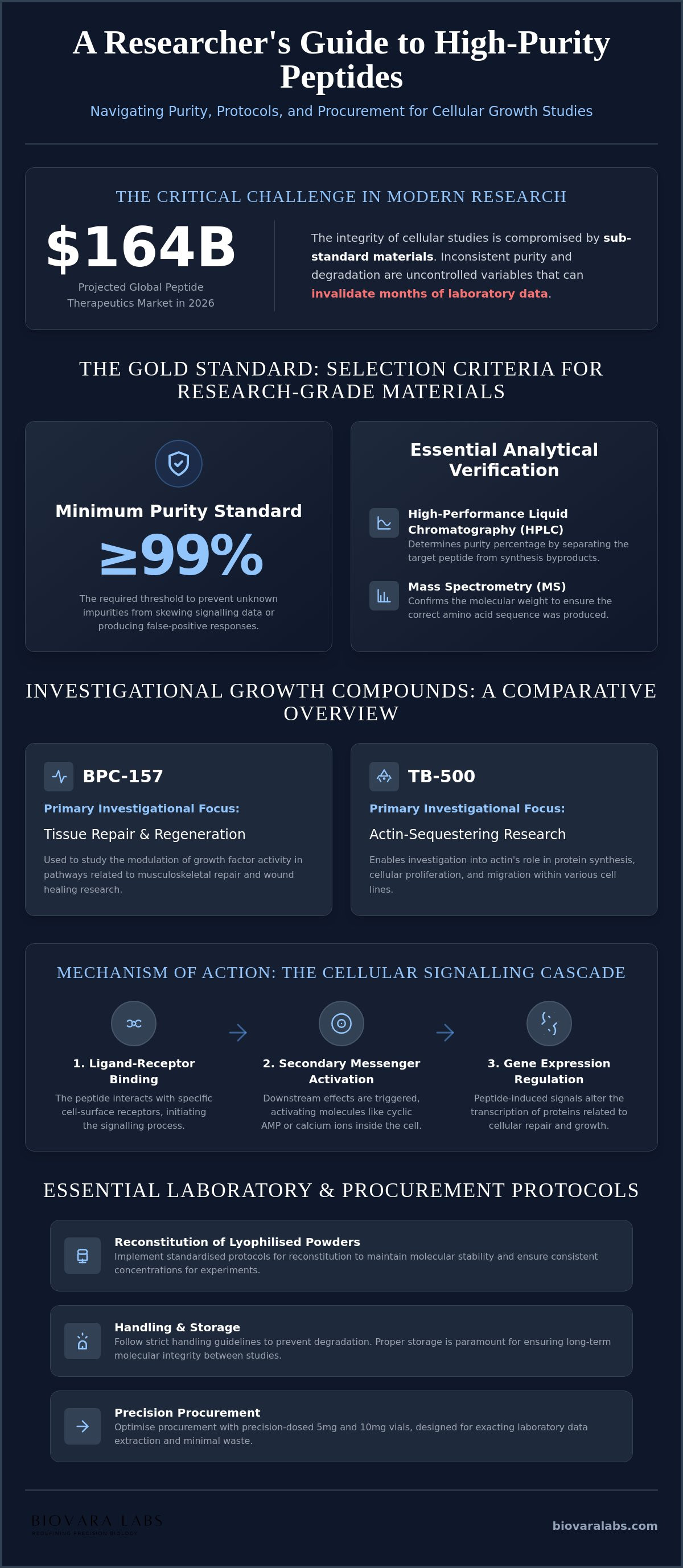
The integrity of a cellular growth study is fundamentally compromised the moment a researcher accepts a certificate of analysis that lacks rigorous HPLC and mass spectrometry verification. In a landscape where the global peptide therapeutics market is projected to reach $164 billion in 2026, the proliferation of sub-standard materials makes the procurement of high-purity research compounds a critical variable. Professional investigators recognize that inconsistent purity levels and material degradation during transit are not merely logistical inconveniences; they are uncontrolled factors that can invalidate months of laboratory data. Accessing reliable peptides for cellular growth studies requires a shift from standard procurement to a disciplined, technical evaluation of molecular integrity and sequence accuracy.
This guide establishes a framework for identifying ≥99% purity research materials and implementing stable laboratory protocols for investigating growth factor activity. It offers a technical evaluation of high-purity research compounds for investigating cellular signalling and regenerative pathways while navigating the 2026 shifts in regulatory oversight. The following analysis details the essential specifications for lyophilised powders and the documentation standards necessary to ensure that investigative outcomes remain reproducible and scientifically sound.
Key Takeaways
- Understand the biochemical role of short-chain amino acid sequences in modulating growth factor activity and cellular proliferation pathways.
- Identify high-integrity peptides for cellular growth studies by prioritising ≥99% purity verified through HPLC and mass spectrometry standards.
- Evaluate the distinct investigational mechanisms of BPC-157 and TB-500 for tissue repair and actin-sequestering research.
- Implement standardised laboratory protocols for the reconstitution and handling of lyophilised powders to ensure long-term molecular stability.
- Optimise procurement through the use of precision-dosed 5mg and 10mg vials designed for exacting laboratory data extraction.
Peptides in Cellular Growth and Signalling Research
Peptides are scientifically defined as short-chain amino acid polymers, typically consisting of 50 or fewer residues, that function as primary signalling molecules within biological systems. Their structural simplicity allows for precise interaction with cellular receptors, making them indispensable tools in the investigation of molecular signalling and tissue regeneration. The application of synthetic peptides for cellular growth studies enables the isolation of specific biochemical pathways, providing a level of experimental control that isn't possible with complex proteins. It's this capacity for targeted intervention that drives the current demand for high-purity research compounds in laboratory environments.
Regenerative molecular biology in 2026 has shifted toward the study of biomimetic sequences that simulate the activity of endogenous growth factors. These investigations focus on the activation of mitogenic pathways and the enhancement of protein synthesis across various cell lines. While researchers examine these pathways in a laboratory setting, individuals aiming to support their own fitness and recovery goals may look to the all-natural supplements and vitamins provided by Fantastic Nutrition. By bypassing the systemic feedback loops present in vivo, researchers can extract high-fidelity data regarding the direct impact of amino acid sequences on cellular proliferation. This methodology is foundational for the development of new protocols in wound healing research and musculoskeletal repair studies.
Mechanisms of Action in Cellular Signalling
The primary mechanism of peptide action involves the binding of ligands to cell-surface receptors, which initiates a cascade of intracellular signalling events. These interactions occur through paracrine or autocrine pathways, influencing the behavior of the target cell or its immediate neighbors. Research parameters often focus on the following molecular interactions:
- Ligand-Receptor Binding Affinity: Measuring the strength of the interaction between the synthetic peptide and receptor tyrosine kinases (RTKs).
- Secondary Messenger Activation: Analysing the downstream effects on molecules like cyclic AMP or calcium ions.
- Gene Expression Regulation: Investigating how peptide-induced signals alter the transcription of proteins related to cellular repair and growth.
Growth Factor Activity in Investigational Environments
Investigating growth factor activity requires the systematic observation of cellular turnover and metabolic shifts. Researchers often use exogenous sequences to modulate the activity of endogenous factors like IGF-1, observing the resulting changes in mitotic rates. It's common for these studies to utilize quantitative assays to measure the synthesis of structural proteins, such as collagen or actin, within the investigational medium.
The extraction of successful data from growth-related pathways relies on the stability of the research materials. Inconsistent peptide purity can lead to off-target effects, which don't just skew results but can invalidate the entire study. Consequently, the focus remains on the use of HPLC-verified compounds to ensure that the observed growth-related outcomes are a direct result of the specific peptide sequence under investigation.
Selection Criteria for Research-Grade Materials
High-fidelity data extraction in cellular biology requires absolute control over the chemical environment. For investigators utilizing peptides for cellular growth studies, the standard for research-grade material is established at ≥99% purity. Materials falling below this threshold introduce unknown organic impurities and isomeric variations that can skew signalling data or produce false-positive mitogenic responses. Sourcing from verified Australian research suppliers ensures that these compounds have undergone rigorous analytical testing before reaching the laboratory bench.
Analytical verification relies on two primary methodologies: High-Performance Liquid Chromatography (HPLC) and Mass Spectrometry (MS). HPLC determines the purity percentage by separating the target peptide from synthesis byproducts, while MS confirms the molecular weight to ensure the correct amino acid sequence was produced. Understanding peptide safety and regulation is critical for researchers, as 'research only' compounds are held to different manufacturing standards than clinical medications. It's through this meticulous documentation that investigators can guarantee a specific growth-related outcome is attributable to the peptide sequence rather than a contaminant.
Interpreting Certificates of Analysis (CoA)
A comprehensive CoA must be batch-specific rather than a generic template. It should detail the purity level, the exact mass found during MS, and the chromatographic profile from HPLC. Researchers must verify that the impurity profile does not include residual solvents or truncated sequences that could interfere with receptor binding. Consistency across multiple research cycles depends on this level of granular detail, allowing for the replication of results in longitudinal studies.
Molecular Integrity and Synthesis Standards
The synthesis of high-tier research compounds requires the removal of trifluoroacetic acid (TFA), a common counter-ion used during the cleavage and purification process. High residual TFA levels can affect the pH of the investigational medium and compromise the stability of the peptide. Professional laboratories prioritize HPLC purity verification in peptide synthesis to ensure that contaminants and acidic residues are minimized. This meticulous approach to manufacturing is central to the research materials provided by Biovara Labs, where every vial is prepared for exacting laboratory use.
Comparative Analysis of Investigational Growth Compounds
The selection of specific sequences for investigational use depends on the targeted biological pathway and the desired resolution of the data. While foundational research often focuses on broad signalling, modern peptides for cellular growth studies require a more nuanced approach to molecular selection. Compounds such as BPC-157 and TB-500 (Thymosin Beta-4) represent the standard for investigating tissue-specific repair mechanisms, yet their biochemical pathways are distinct. Understanding these differences is essential for researchers aiming to isolate specific variables in cellular proliferation and metabolic regulation.
Scientific literature regarding peptide hormones and growth factors highlights how these molecules initiate complex cascades that influence cellular turnover. For instance, BPC-157, a 15-amino-acid sequence derived from human gastric juice, is frequently studied for its role in upregulating growth hormone receptors and promoting angiogenic responses. In contrast, TB-500 functions primarily through actin-sequestering mechanisms, influencing the migration of cells to sites of injury. These distinct modes of action allow for a diversified research portfolio, addressing both systemic signalling and localised structural repair.
BPC-157 vs. TB-500: Complementary Pathways
A technical comparison of BPC-157 and TB-500 reveals a complementary relationship rather than a redundant one. BPC-157's research profile is heavily weighted toward the protection of the endothelium and the modulation of the nitric oxide system. TB-500, specifically the active 17-amino acid fragment of Thymosin Beta-4, is investigated for its capacity to bind G-actin, thereby facilitating cellular motility and structural integrity. Laboratory investigations often utilize these compounds in tandem to observe synergistic effects on cellular repair pathways, provided the sequence data for each batch is verified for absolute structural integrity.
Advanced Metabolic Compounds: MOTS-c and NAD+
The investigation of cellular growth also extends into the mitochondrial genome and energetic cofactors. MOTS-c is a mitochondrial-derived peptide that regulates metabolic homeostasis and promotes cellular longevity through the AMPK pathway. This 16-amino-acid sequence provides a unique lens into mitochondrial-to-nuclear signalling, a critical component of metabolic growth studies. Similarly, NAD+ research peptides focus on the activation of sirtuins and the facilitation of DNA repair. Procurement of these high-concentration compounds requires strict adherence to stability standards, as metabolic peptides are particularly sensitive to thermal degradation during the synthesis and transport phases.
Laboratory Handling and Stability Protocols
Peptide stability is contingent upon the maintenance of molecular structure during laboratory storage and manipulation. The primary method for ensuring the integrity of peptides for cellular growth studies is lyophilisation, a process that removes moisture to inhibit enzymatic degradation and chemical hydrolysis. This state of "freeze-drying" preserves the amino acid sequence in a stable, solid matrix, allowing for long-term storage without compromising the purity levels established during synthesis. When researchers don't adhere to strict handling protocols, the risk of molecular fragmentation increases, potentially invalidating subsequent data extraction.
Mechanical stress and ultraviolet (UV) radiation represent significant risks to peptide stability. Agitation or vigorous shaking can lead to protein denaturation or aggregation, rendering the research material unusable for precise investigation of growth-related pathways. UV exposure triggers photochemical reactions that can cleave peptide bonds or alter side chains. Researchers must maintain a controlled environment where vials remain shielded from light and physical disruption throughout the investigational cycle. It's this level of environmental control that separates rigorous laboratory study from casual experimentation.
This commitment to a controlled environment often extends to the management of research facilities and surrounding grounds; for those looking to protect their outdoor spaces from pests naturally, check out Revira.
Step-by-Step Reconstitution for Researchers
The transition from a lyophilised state to a liquid reagent requires precise handling to prevent molecular damage. Researchers must use aseptic techniques to maintain the purity of the compound during this phase. The following steps ensure the preservation of the peptide's structural integrity:
- Calculation of Ratios: Determine the volume of solvent needed based on the desired concentration, such as 2mg/mL or 5mg/mL.
- Solvent Introduction: Use Bacteriostatic Water for its antimicrobial properties. Slowly introduce the liquid along the interior wall of the vial to avoid direct impact on the powder.
- Dissolution Period: Allow the vial to rest undisturbed for approximately 5 to 10 minutes. Complete dissolution should occur without the need for agitation or swirling.
Long-Term Storage and Shelf Life
The shelf life of these compounds is strictly temperature-dependent and varies based on the physical state of the material. Lyophilised vials are most stable when stored at -20°C, a temperature that minimizes molecular motion and degradation over extended periods. For active research windows, storage at 2-8°C is acceptable, provided the vials are protected from moisture and light. Reconstituted peptides exhibit a significantly shorter shelf life and are prone to degradation within days or weeks, depending on the specific sequence.
Researchers should avoid repeated freeze-thaw cycles, as the resulting ice crystal formation and osmotic shifts can cause molecular fragmentation. Adhering to the Research Peptide Storage Protocols for Laboratories ensures that the integrity of the compound is maintained from procurement to data extraction. For high-purity materials designed for rigorous investigation, researchers can source through Biovara Labs to ensure controlled handling and stability standards are met.
Procuring Materials: The Performance & Growth Collection
Procurement of high-integrity materials requires a framework that aligns with the analytical standards discussed in previous chapters. The Biovara Labs Performance & Growth Collection is engineered to meet these requirements through the provision of standardised, lyophilised sequences. Every compound within this collection is housed in securely sealed vials, specifically designed to withstand the rigours of Australian laboratory logistics. This ensures that the ≥99% purity levels verified at the point of synthesis remain intact until the point of reconstitution. Investigators can rely on these materials to maintain consistency across multiple experimental cycles.
Laboratory precision is facilitated by the availability of standardised 5mg and 10mg vials. These specific formats allow for the accurate calculation of dilution ratios without the waste associated with larger, bulk-format containers. All materials in this collection are strictly designated for 'Research Use Only' (RUO). This classification ensures that the compounds are utilised solely for in vitro or analytical investigation, upholding the legal and ethical standards of the scientific community. Sourcing peptides for cellular growth studies from a dedicated provider ensures that these RUO designations are respected and documented.
Featured Compounds for Growth Studies
The Performance & Growth Collection includes a range of sequence-verified compounds tailored for specific investigational needs. Each vial is prepared using meticulous manufacturing processes to ensure molecular stability. Researchers often utilise the following featured materials:
- BPC-157 Research Peptide (5mg): A high-purity lyophilised powder investigated for its role in gastric-derived signalling and tissue repair pathways.
- TB-500 Research Peptide (5mg): A sequence-verified fragment of Thymosin Beta-4, utilised for the study of actin-sequestering and cellular motility.
- MOTS-c (10mg): An advanced mitochondrial-derived compound designed for the investigation of metabolic growth and nuclear-mitochondrial signalling.
Procurement Logistics and Compliance
Reagent preparation is a critical component of the investigative process. The availability of Bacteriostatic Water in 30ml formats allows researchers to maintain aseptic conditions during the transition of these compounds from a solid to a liquid state. Shipping and handling standards for peptides for cellular growth studies are similarly rigorous. Biovara Labs employs temperature-controlled logistics to mitigate the risk of thermal degradation, preserving the molecular integrity of the peptide during transit through the Australian research network.
Adhering to these procurement standards ensures that the focus remains on successful data extraction rather than the management of material inconsistencies. For laboratories requiring HPLC-verified sequences and secure handling, the choice of supplier is a foundational element of the research protocol. You may Browse the Performance & Growth Collection for High-Purity Research Peptides to secure the materials necessary for your next phase of cellular investigation.
Advancing Molecular Precision in Cellular Research
The extraction of high-fidelity data from peptides for cellular growth studies is predicated on the absolute mitigation of analytical variables. As established, the transition from procurement to laboratory implementation requires a disciplined approach to molecular integrity, prioritizing ≥99% HPLC verified purity and sequence accuracy. Adhering to the stability protocols for lyophilised powders and aseptic reconstitution isn't merely a procedural suggestion; it's a fundamental requirement for maintaining the reliability of signalling data. By ensuring Australian research standard compliance and utilizing professional laboratory grade materials, investigators can focus on the complexities of regenerative pathways with confidence in their reagent quality.
Establishing this foundation of chemical certainty allows for the advancement of scientific understanding without the interference of synthesis byproducts or degraded sequences. Researchers who require exacting standards for their investigational environments can Secure High-Purity Peptides for Your Research at Biovara Labs. The commitment to precision in manufacturing and logistics supports the ongoing discovery of novel cellular growth mechanisms.
Frequently Asked Questions
What purity level is required for peptides in cellular growth studies?
A purity level of ≥99% is the established benchmark for high-fidelity research. This standard ensures that the biological responses observed are a direct result of the specific peptide sequence rather than organic impurities or synthesis byproducts. Lower purity levels introduce uncontrolled variables that can compromise the integrity of data extraction in peptides for cellular growth studies. It's the standard required for professional laboratory precision.
How should BPC-157 be stored to maintain its molecular integrity?
Lyophilised BPC-157 must be stored in a temperature-controlled environment, ideally at -20°C, to ensure long-term molecular stability. Once the compound is reconstituted, it should be kept at 2-8°C and shielded from UV exposure to prevent rapid degradation. Maintaining these conditions is critical for preserving the structural integrity of the 15-amino-acid sequence during the investigative cycle. It's essential that researchers avoid repeated freeze-thaw cycles.
What is the difference between BPC-157 and TB-500 in research environments?
The primary distinction lies in their biochemical pathways; BPC-157 focuses on endothelial protection and nitric oxide modulation, while TB-500 targets actin-sequestering mechanisms. While both are used in tissue repair research, TB-500 specifically facilitates cellular motility through G-actin binding. Researchers often select the compound based on whether the study aims to investigate systemic signalling or localized structural repair. It's common to see these compounds used in complementary research stacks.
Why is bacteriostatic water preferred for peptide reconstitution?
Bacteriostatic water is the preferred diluent because it contains 0.9% benzyl alcohol, which inhibits the growth of potential bacterial contaminants. This antimicrobial property is essential for maintaining reagent purity over multiple uses from a single vial. Using sterile water without bacteriostatic agents increases the risk of rapid degradation and contamination, which can invalidate the outcomes of peptides for cellular growth studies. It's the standard reagent for maintaining aseptic conditions.
Can research peptides be shipped internationally without degradation?
International shipping is feasible provided the materials are in a lyophilised state and handled through temperature-controlled logistics. The freeze-dried format significantly enhances resistance to thermal fluctuations during transit. Securely sealed vials and professional packaging standards are necessary to mitigate the risk of mechanical stress and UV exposure during the logistical process. It's through these exacting standards that molecular integrity is preserved across long distances.
What documentation should I expect with a research peptide order?
A professional research peptide order must include a batch-specific Certificate of Analysis (CoA) featuring HPLC and Mass Spectrometry data. These documents verify the purity percentage and confirm the molecular weight of the sequence. This level of technical documentation is indispensable for establishing stable laboratory protocols and ensuring the reproducibility of research findings. It's the only way to verify that the material meets the required ≥99% purity benchmark.
How do I calculate the concentration of a reconstituted peptide vial?
Concentration is calculated by dividing the total mass of the peptide by the volume of the diluent introduced. For instance, adding 2ml of bacteriostatic water to a 5mg vial results in a concentration of 2.5mg/ml. Precise measurement of the solvent is required to ensure that the resulting reagent meets the specific requirements of the investigational protocol. It's a fundamental step that dictates the precision of the experimental data.


