
Sourcing Peptides for Regenerative Research: A 2026 Laboratory Procurement Guide
The structural integrity of a regenerative study is fundamentally limited by the analytical purity of its underlying chemical ligands. While the global peptide therapeutics market is projected to reach approximately A$245 billion in 2026, the proliferation of non-verified suppliers has introduced significant variables into the laboratory environment. For investigators sourcing peptides for regenerative research, the difference between a 95% purity grade and the 99% industry standard isn't merely a technicality; it's the boundary between reproducible data and experimental failure.
You've likely encountered the frustrations of peptide degradation during transit or the persistent absence of batch-specific HPLC data from various suppliers. This guide establishes a rigorous framework for evaluating high-purity regenerative ligands and implementing precise reconstitution protocols. We'll analyze the latest 2026 regulatory shifts, compare the structural specifications of repair sequences such as BPC-157 and TB-500, and define the verification metrics necessary for systematic laboratory investigation within the Australian scientific community.
Key Takeaways
- Define the functional role of bioactive peptides (BAPPs) in modulating cellular microenvironments and exosome signaling within modern regenerative science.
- Establish a verification framework for peptides for regenerative research that prioritizes ≥99% purity and molecular weight accuracy via mass spectrometry.
- Evaluate the specific angiogenic and actin-sequestering pathways of BPC-157 and TB-500 to ensure alignment with laboratory repair models.
- Master standardized reconstitution protocols using laboratory-grade bacteriostatic water to maintain reagent stability and precise experimental concentrations.
- Optimize procurement strategies by identifying vacuum-sealed, lyophilized materials that resist degradation during national transit across Australia.
The Landscape of Peptides for Regenerative Research in 2026
Bioactive peptides (BAPPs) serve as high-affinity signaling molecules within the current framework of regenerative science. These short-chain amino acids function as precise ligands, binding to specific cell-surface receptors to initiate complex intracellular cascades. The Landscape of Peptides in 2026 has evolved beyond basic hormonal replacement toward the sophisticated modulation of the cellular microenvironment and exosome-mediated communication. This evolution is particularly evident in the study of paracrine signaling, where exogenous peptides influence the secretome of mesenchymal stem cells to accelerate tissue restoration.
Current investigations focus heavily on mitochondrial-driven recovery and the orchestration of angiogenic responses. Researchers are increasingly utilizing peptides for regenerative research to explore the metabolic stabilization of damaged tissues. By targeting mitochondrial efficiency, these ligands help mitigate the energetic deficits associated with cellular senescence. High-purity reagents are essential for these applications. Minor contaminants can alter exosomal cargo or disrupt the delicate balance of growth factor expression, leading to skewed experimental outcomes.
Molecular Signaling and Tissue Repair Pathways
The efficacy of regenerative ligands is often measured by their ability to neutralize reactive oxygen species (ROS) within laboratory models. Excessive ROS production typically stalls the repair phase; therefore, sequences that upregulate antioxidant enzymes are critical for study integrity. Parallel research emphasizes the importance of vascular endothelial growth factor (VEGF) upregulation. Inducing controlled angiogenesis is a primary objective in musculoskeletal and dermal repair studies. Key focuses in these pathways include:
- The reduction of oxidative stress markers in vitro to preserve cellular viability.
- The acceleration of endothelial cell proliferation to support neo-vascularization.
- The modulation of cytokine profiles to favor resolution over chronic inflammation.
Specific amino acid sequences are also scrutinized for their immune-modulatory effects, specifically their capacity to shift macrophage polarization from a pro-inflammatory M1 phenotype to a pro-repair M2 state. This shift is a prerequisite for successful tissue integration in regenerative models.
Synthetic Standards for Research Reagents
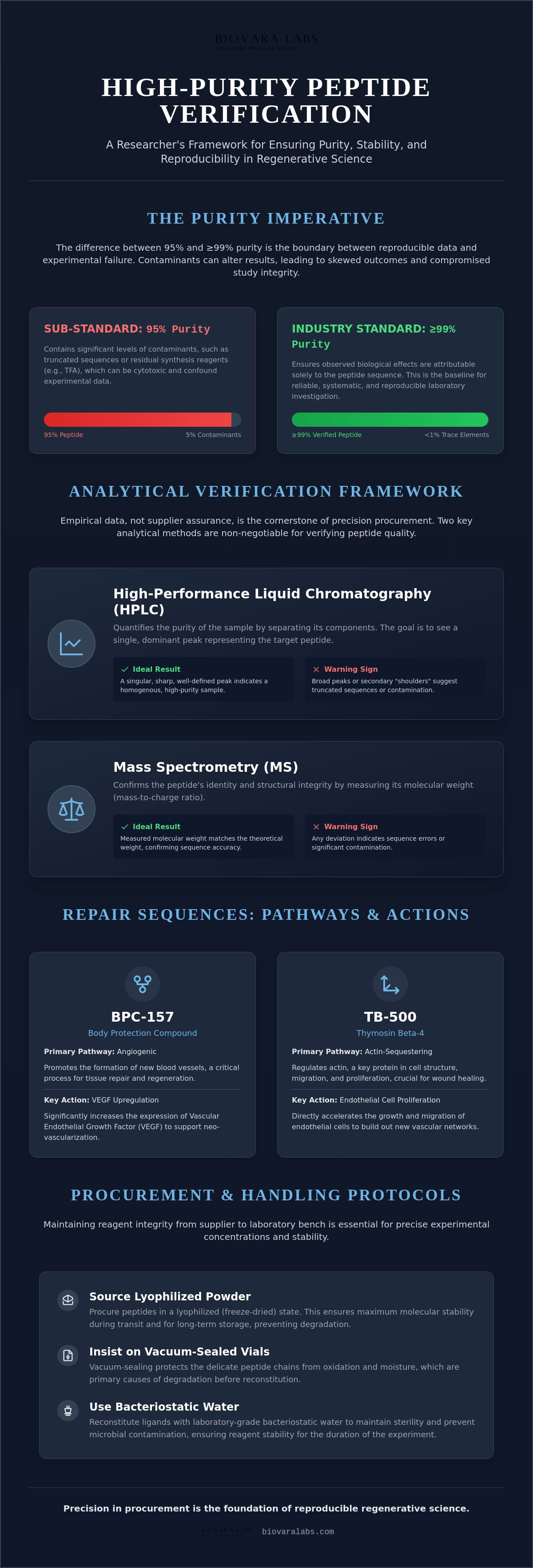
Synthetic peptide ligands offer superior experimental control compared to naturally derived proteins. Natural extracts often suffer from batch-to-batch variability and potential immunogenic contaminants that confound data. Modern laboratory procurement in Australia favors high-concentration lyophilized powders to ensure molecular stability during national transit and long-term storage. The industry standard for research-grade peptide purity is defined as ≥99% as verified by High-Performance Liquid Chromatography (HPLC). This level of precision ensures that observed biological effects are attributable solely to the peptide sequence rather than residual trifluoroacetic acid (TFA) or truncated sequences. Vacuum-sealed, freeze-dried reagents provide the baseline for reproducible data in systematic investigation.
Analytical Metrics for Procurement Selection
Precision in the procurement of peptides for regenerative research requires empirical verification rather than mere supplier assurance. Mass spectrometry (MS) serves as the primary tool for confirming sequence accuracy by measuring the mass-to-charge ratio of ionized particles. This process verifies that the synthesized peptide aligns exactly with its theoretical molecular weight. Any deviation, even fractional, indicates a sequence error or the presence of significant contamination that could compromise experimental integrity. Without MS data, researchers risk utilizing materials with incorrect amino acid orientations.
High-Performance Liquid Chromatography (HPLC) complements MS by quantifying chemical purity levels. An HPLC report provides a visual representation of the sample's composition through chromatography peaks. Researchers must identify a singular, sharp peak as the primary indicator of a homogenous sample. Broad peaks or secondary "shoulders" suggest the presence of truncated sequences or residual reagents from the synthesis process. One specific concern is trifluoroacetic acid (TFA), a counter-ion used during solid-phase peptide synthesis. Excessive TFA concentrations are often cytotoxic in cell culture models, potentially confounding results in regenerative studies. Identifying and mitigating TFA through proper salt-exchange processes is a hallmark of high-tier laboratory reagents.
Laboratories investigating tissue repair pathways often utilize verified recovery ligands to ensure that observed biological responses are attributable solely to the peptide sequence rather than manufacturing byproducts.
Interpreting Certificates of Analysis (CoA)
A CoA functions as a technical specification rather than a generic quality claim. Verification involves checking the purity percentage, which should meet the ≥99% threshold for sensitive quantitative assays. Researchers should compare the "found" molecular weight against the "calculated" value to identify discrepancies caused by salt content or moisture. Demanding batch-specific HPLC/MS data is a necessary safeguard to ensure the material in the vial matches the provided analytical data, preventing the use of subpar reagents in high-value investigations.
Stability Variables in National Logistics
Peptide structural integrity is vulnerable to environmental stressors during transit. Temperature fluctuations across Australia can trigger premature degradation if the reagent isn't properly stabilized. Lyophilization, or freeze-drying, increases shelf life by removing water through sublimation. Vacuum-sealed vials further protect this lyophilized cake from moisture ingress and oxidation, which can lead to peptide hydrolysis. Lyophilized peptides remain stable at room temperature for short durations during shipping but require cold storage upon arrival. Maintaining a consistent cold chain or immediate transfer to -20°C storage is essential for preserving the secondary structure of high-value regenerative compounds over extended periods.
Comparative Evaluation: The Recovery & Repair Collection
Systematic investigation into regenerative pathways requires a comparative understanding of available ligands and their specific binding affinities. Researchers selecting peptides for regenerative research must distinguish between sequences that modulate systemic growth factors and those that target localized cellular structures. The Recovery & Repair Collection provides a technical baseline for these investigations, offering compounds with verified sequence accuracy for various tissue repair models.
BPC-157 (A$54.99-A$90.99) is a stable gastric pentadecapeptide frequently investigated for its angiogenic properties and its influence on musculoskeletal repair pathways. Its 15-amino acid sequence is derived from a naturally occurring protein in gastric juice, and it's scrutinized for its capacity to upregulate vascular endothelial growth factor (VEGF) receptors. In contrast, TB-500 (A$49.99-A$149.99) functions as a synthetic analogue of the active region of Thymosin Beta-4. Research regarding TB-500 focuses primarily on its actin-sequestering mechanisms, which facilitate cell migration and wound healing through G-actin binding. Researchers should consult the comprehensive review on Research Peptides Australia: Analytical Standards and Sourcing Protocols for 2026 to align these selections with broader laboratory standards.
Sequence Analysis: BPC-157 vs. TB-500
The structural differences between these two ligands dictate their intended research applications. While BPC-157 is a relatively short sequence focused on localized angiogenic signaling, TB-500 utilizes a specific domain to promote systemic cell motility. Investigations into multi-pathway signaling often utilize the Glow Stack (A$190.99). This combination allows for the simultaneous study of synergies between TB-500, BPC-157, and GHK-Cu, particularly in dermal and connective tissue regeneration models. These multi-ligand stacks help researchers observe how different signaling cascades interact within a singular microenvironment.
While these research stacks explore biochemical synergies, the aesthetic industry achieves complementary results through advanced physical modalities; for example, CoolSlimming Aesthetics provides precision devices designed for non-invasive body contouring and tissue optimization.
Mitochondrial and Metabolic Signaling Ligands
Advanced regenerative studies often extend beyond tissue architecture to address metabolic efficiency and oxidative stress. SS-31 (A$119.99-A$449.99), also known as Elamipretide, is an aromatic-cationic tetrapeptide that targets the inner mitochondrial membrane. It binds specifically to cardiolipin, stabilizing mitochondrial cristae and reducing the production of reactive oxygen species (ROS). Other metabolic ligands include:
- ARA-290 (A$139.99): An erythropoietin-derived peptide investigated for its interaction with the innate repair receptor (IRR) to modulate inflammatory responses.
- AOD-9604 (A$59.99-A$109.99): A C-terminal fragment of human growth hormone researched for its roles in lipid metabolism and cartilage repair pathways.
- MGF (A$89.99) and PEG-MGF (A$69.99): Variants of Mechano-Growth Factor used to study muscle-specific hypertrophy and satellite cell activation, with PEGylation offering increased half-life for extended observation.
The Recovery & Repair Collection provides direct access to these HPLC-verified compounds, ensuring that experimental variables remain restricted to the biological hypotheses rather than reagent quality.
Post-Procurement Handling and Reagent Stability
Reconstitution represents a critical transition phase where the structural integrity of peptides for regenerative research is most vulnerable. The process of converting a lyophilized powder into a liquid reagent requires meticulous attention to solvent choice and mechanical force. Mechanical stress, specifically peptide shearing, occurs when solvents are introduced too forcefully or when vials are agitated aggressively. Such physical disruption can break delicate peptide bonds, leading to truncated sequences that no longer exhibit the intended biological activity. Researchers must prioritize a gentle, controlled dissolution process to maintain the ligand's secondary structure.
Precise experimental applications depend on accurate concentration calculations. Determining mg/mL ratios is a foundational step in laboratory protocol. For example, introducing 2mL of diluent into a 5mg vial yields a concentration of 2.5mg/mL. This standardization allows for the exact micro-dosing required in cellular signaling studies. Once reconstituted, the peptide's half-life significantly decreases compared to its lyophilized state. While vacuum-sealed powders remain stable for extended periods, liquid reagents require immediate use or specialized storage. For longitudinal studies, maintaining reagents at -20°C or -80°C is mandatory to prevent hydrolysis and enzymatic degradation. Repeated freeze-thaw cycles must be avoided, as they induce cumulative structural damage.
To ensure the longevity of your laboratory materials, you can source high-grade recovery and repair ligands that are specifically formulated for high-stability research applications.
Reconstitution Best Practices
The use of Bacteriostatic Water (A$13.99-A$19.99) is the established standard for multi-use research vials. Its 0.9% benzyl alcohol preparation acts as a critical preservative, preventing microbial proliferation that could otherwise contaminate the research environment. Sterile water, while suitable for single-use applications, is insufficient for vials accessed multiple times. Solvent introduction should occur via the vacuum-sealed vial wall; the liquid should trickle down the glass rather than impacting the lyophilized cake directly. This technique minimizes air bubble formation and protects the peptide's molecular integrity during the transition to a liquid state.
Handling and Safety Data Protocols
Maintaining a sterile environment during the aliquot process is essential for data reproducibility. Researchers must utilize appropriate safety equipment, including nitrile gloves and calibrated micropipettes, to handle high-purity chemicals. All laboratory waste, including used research vials and contaminated sharps, must be disposed of according to national biohazard regulations. By adhering to these rigorous handling protocols, investigators preserve the analytical grade of their reagents and ensure that experimental variables remain restricted to the biological hypotheses under investigation.
Strategic Sourcing and Laboratory Compliance
Establishing a reliable supply chain serves as the final, yet most critical, infrastructure requirement for regenerative investigation. Australian researchers frequently prioritize Biovara Labs for its uncompromising adherence to a ≥99% purity baseline. This commitment to analytical precision ensures that experimental data remains insulated from confounding variables introduced by chemical impurities or truncated sequences. Vacuum-sealed structural integrity is a standard feature of every reagent, specifically designed to withstand the environmental stressors associated with national transit across diverse Australian climates.
Logistics security directly impacts the viability of sensitive peptides for regenerative research. Secure, national delivery protocols mitigate the risk of thermal degradation, ensuring that lyophilized ligands arrive in their optimal chemical state for immediate laboratory use. For investigators conducting multi-phase longitudinal studies throughout 2026, batch consistency is a paramount concern. Accessing materials from a singular, technically reliable source prevents the sequence drift that often occurs when procurement is fragmented across non-verified suppliers. This reliability is essential for maintaining the integrity of peer-reviewed data and institutional standards.
Just as researchers rely on verified vendors for scientific components, discerning consumers in other sectors look to established experts like Gotham Cigars to guarantee the quality and authenticity of specialized products.
The Biovara Recovery & Repair Standard
Biovara maintains a rigorous verification protocol for its entire catalog, providing HPLC-verified vials for essential repair sequences. This includes specialized ligands such as BPC-157 Research Peptide, TB-500 Research Peptide, and SS-31. These materials are intended strictly for laboratory investigation and systematic research purposes. Compliance with non-human consumption standards is strictly maintained, positioning the brand as a specialized provider for Australian scientific institutions. Comprehensive technical documentation is available to support the exacting requirements of laboratory reporting and institutional compliance, ensuring that every research phase is backed by empirical data.
Securing High-Purity Research Materials
Streamlined procurement of specialized stacks allows for the efficient investigation of multi-ligand synergies within a controlled environment. Maintaining a consistent research supply chain is essential for the reproducibility of complex regenerative models, especially when investigating angiogenic or mitochondrial pathways over several months. By eliminating the uncertainty associated with inconsistent purity levels, investigators can focus entirely on the advancement of scientific understanding and the modulation of cellular repair pathways. Secure high-purity ligands from the Biovara Recovery & Repair Collection to advance your 2026 research with analytical certainty.
Advancing Regenerative Discovery Through Analytical Precision
The integrity of laboratory outcomes depends on the exacting standards of the reagents utilized. As research into regenerative pathways accelerates, the necessity for high-purity peptides for regenerative research becomes paramount. Achieving reproducible data requires a commitment to ≥99% purity levels and rigorous batch verification via HPLC and mass spectrometry. These analytical metrics ensure that observed biological interactions are the result of the intended sequence rather than manufacturing artifacts.
Beyond initial procurement, maintaining structural stability through proper lyophilization and standardized reconstitution protocols is essential for longitudinal success. Biovara Labs serves as a dedicated national Australian research supplier, providing vacuum-sealed, lyophilized materials that withstand the complexities of transit and storage. By prioritizing technical reliability and comprehensive documentation, investigators can eliminate reagent-based variables from their systematic studies. Browse the Recovery & Repair Collection to secure HPLC-verified ligands that meet the highest standards of laboratory precision. We look forward to supporting the next generation of your scientific breakthroughs.
Frequently Asked Questions
What is the primary difference between BPC-157 and TB-500 in regenerative research?
BPC-157 is a pentadecapeptide primarily investigated for its angiogenic properties and localized musculoskeletal repair pathways. TB-500 is a synthetic analogue of the G-actin binding domain of Thymosin Beta-4. While BPC-157 focuses on growth factor upregulation, TB-500 is utilized to study cellular migration and motility through actin-sequestering mechanisms. These distinct pathways require different experimental models depending on the regenerative focus of the study.
Why is HPLC purity verification essential for peptides for regenerative research?
HPLC verification ensures that peptides for regenerative research meet the industry-standard ≥99% purity threshold. This analytical metric is essential for eliminating residual reagents or truncated sequences that act as confounding variables. High-purity reagents prevent unintended cytotoxic effects in cell culture models. Without HPLC data, researchers cannot definitively attribute biological responses solely to the target peptide sequence.
How should lyophilized research peptides be stored to ensure long-term stability?
Lyophilized reagents should be stored in a temperature-controlled environment at -20°C or -80°C for extended durations. While vacuum-sealed vials remain stable at room temperature for short transit periods, immediate refrigeration upon arrival is mandatory. Protecting the lyophilized cake from moisture ingress and UV exposure preserves the molecular integrity of the compound. Reconstituted peptides require even stricter cold-chain management to prevent hydrolysis.
What is the role of SS-31 (Elamipretide) in mitochondrial-focused research?
SS-31 functions as an aromatic-cationic tetrapeptide that binds specifically to cardiolipin within the inner mitochondrial membrane. Its primary role in research involves the stabilization of mitochondrial cristae and the reduction of reactive oxygen species production. Investigators utilize SS-31 to explore metabolic efficiency and the mitigation of oxidative stress in various tissue models. It's a critical ligand for studies targeting mitochondrial dysfunction.
How much bacteriostatic water is required for reconstituting a 5mg BPC-157 vial?
The volume of Bacteriostatic Water depends on the specific concentration requirements of the laboratory protocol. A standard reconstitution using 2mL of diluent for a 5mg vial results in a concentration of 2.5mg/mL. Researchers often adjust this ratio to achieve precise micro-dosing for cellular signaling assays. It's essential to introduce the solvent slowly via the vial wall to prevent mechanical stress and peptide shearing.
Are the peptides in the Recovery & Repair collection suitable for human consumption?
No, these materials are strictly for laboratory investigation and in vitro research. Compounds within the Recovery & Repair collection are not intended for human consumption or therapeutic use. Compliance with Australian laboratory regulations requires that these reagents be handled only by qualified personnel in a controlled environment. Every vial is labeled specifically for research use to ensure institutional and regulatory compliance.
How does PEGylation affect the research profile of MGF peptides?
PEGylation involves the attachment of polyethylene glycol chains to the MGF sequence to increase its metabolic stability. This modification extends the peptide's half-life, allowing for longer observation windows in muscle tissue research. While standard MGF is rapidly degraded by proteases, PEG-MGF facilitates longitudinal studies into satellite cell activation and hypertrophy. It's a specialized tool for researchers requiring sustained signaling in their experimental models.
Does Biovara Labs provide Certificates of Analysis for each research peptide batch?
Biovara Labs provides batch-specific Certificates of Analysis (CoA) for its entire catalog of peptides for regenerative research. Each CoA includes High-Performance Liquid Chromatography reports for purity verification and Mass Spectrometry data for identity confirmation. This documentation allows researchers to verify that the found molecular weight matches the theoretical value before initiating sensitive quantitative assays. It ensures empirical accuracy across all experimental phases.


