
Australia Research Peptide Delivery: Technical Logistics and Stability Protocols
The structural integrity of a lyophilised compound isn't a static attribute; it's a variable dependent on the precision of its logistics chain. For the scientific community, the standard for Australia research peptide delivery must transcend simple transit speed to prioritise the preservation of molecular sequences against thermal fluctuations. Researchers frequently identify thermal exposure and opaque shipping protocols as primary catalysts for molecular degradation, which compromises the analytical value of a batch before it reaches the laboratory. This instability often undermines the reproducibility of data and results in significant setbacks for critical research timelines.
This article provides a technical examination of the logistical standards required to maintain the molecular integrity of research compounds during Australian transit. You'll learn how specific stability protocols and batch-specific verification data ensure the receipt of high-purity materials for laboratory application. The following sections detail the requirements for minimising transit durations and the implementation of rigorous purity verification to support the advancement of scientific discovery.
Key Takeaways
- Understand the critical relationship between supply chain precision and the reproducibility of experimental data in Australian laboratories.
- Identify the specific logistical standards required for Australia research peptide delivery to prevent molecular sequence degradation during transit across vast national distances.
- Examine the molecular science of lyophilisation and how maintaining a dehydrated state protects research compounds from hydrolysis and enzymatic breakdown.
- Evaluate the risks associated with international procurement, specifically regarding temperature fluctuations and delays during Australian Border Force (ABF) inspections.
- Establish rigorous laboratory protocols for the receipt and immediate transition of research peptides to long-term storage at -20°C or -80°C.
The Logistics of Scientific Integrity: Research Peptide Delivery in Australia
Scientific integrity is fundamentally linked to the physical state of the reagents utilised in laboratory environments. The process of Australia research peptide delivery requires a sophisticated understanding of the biochemical vulnerabilities inherent in short-chain amino acids. Professional researchers prioritise standardised delivery protocols over generic courier services because the latter often lacks the specialised infrastructure required to preserve molecular sequences. A failure in the logistical chain doesn't just delay a project; it introduces uncontrolled variables that can invalidate months of experimental data. Maintaining a strict chain of custody ensures that the transition from a controlled manufacturing environment to the laboratory freezer occurs without compromising the compound's chemical state.
The distribution of high-purity chemical compounds across the vast Australian geography necessitates a rigorous logistical framework. Standard shipping networks aren't designed for the sensitivities of peptide therapeutics and research analogues, which can undergo rapid degradation if exposed to kinetic stress or thermal instability. Sophisticated suppliers treat the transit phase as an extension of the laboratory environment. This approach involves the use of reinforced, insulated packaging and expedited routing to minimise the window of environmental exposure. By treating logistics as a technical specification rather than a peripheral service, suppliers provide the reliability required for reproducible scientific study.
Regulatory Framework for Laboratory Reagent Distribution
Research peptides are classified as non-therapeutic laboratory reagents, a distinction that dictates specific handling and documentation requirements under Australian law. Compliance involves adhering to the standards for the transport of chemical compounds, ensuring that all materials are clearly labelled for "Research Use Only." Domestic transit of these materials requires precise manifest documentation to verify the nature of the compounds and their intended laboratory application. This regulatory transparency is essential for maintaining professional standards within the Australian scientific community.
The Impact of Australian Environmental Variables
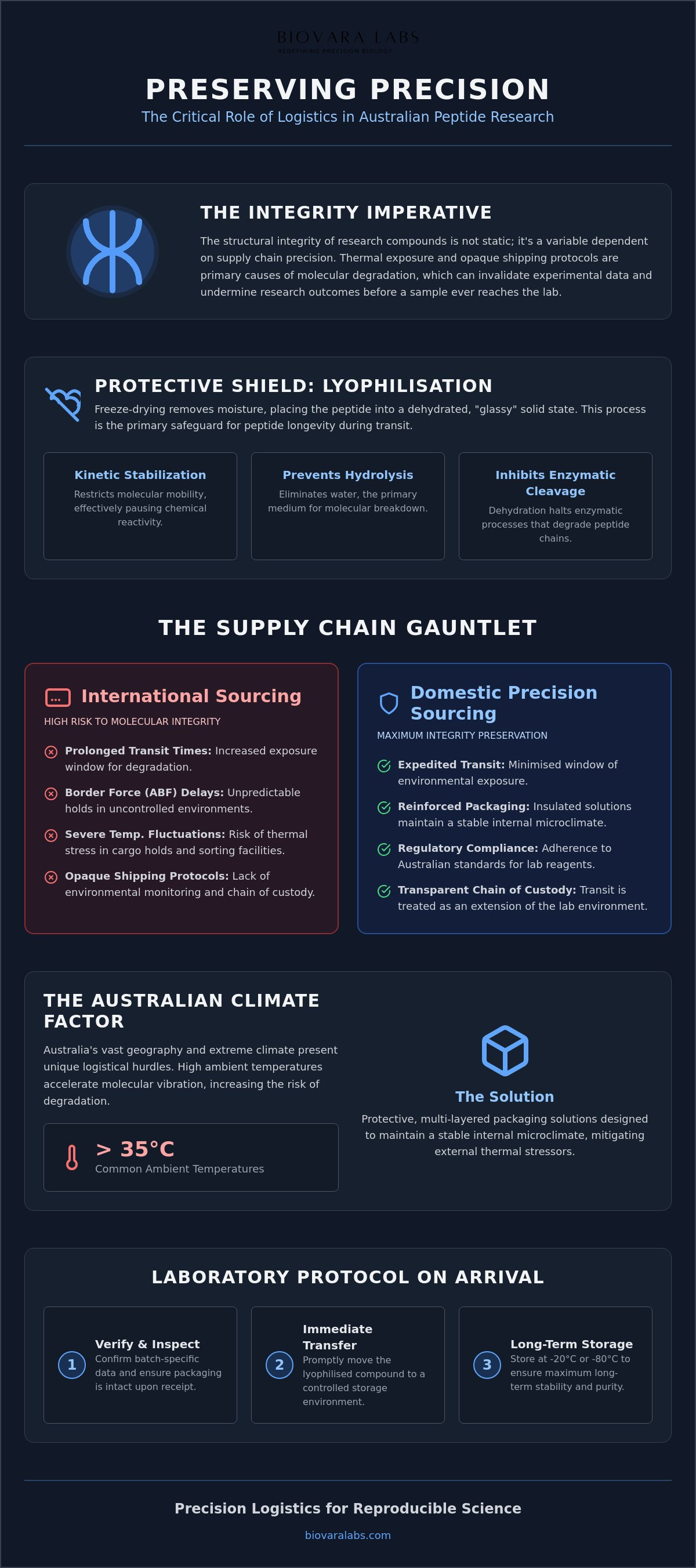
Australian researchers face unique challenges due to extreme ambient temperatures that frequently exceed 35°C in many regions. High thermal energy accelerates the vibration of molecular peptide bonds, increasing the risk of sequence degradation or premature denaturation. Standard logistics networks often experience significant thermal fluctuations in sorting facilities and delivery vehicles. Mitigating these stressors requires protective, multi-layered packaging solutions designed to maintain a stable internal microclimate. Without these technical safeguards, the structural integrity of the peptide can be compromised before the package is even opened.
Consistency in research outcomes is only possible when the starting materials are verified as stable and pure. Professional Australia research peptide delivery protocols eliminate the ambiguity associated with standard shipping, providing researchers with the confidence that their reagents remain at peak analytical grade throughout the entire transit process.
Lyophilisation and Stability: Maintaining Structural Integrity During Transit
Lyophilisation is the primary safeguard for peptide longevity in non-refrigerated transit. This process, commonly known as freeze-drying, involves the removal of solvent from a frozen product through sublimation under a vacuum. For the purposes of Australia research peptide delivery, this physical state is essential. By eliminating moisture, the peptide enters a dehydrated, "glassy" solid state that significantly restricts molecular mobility. This kinetic stabilisation prevents the primary mechanisms of degradation that occur in aqueous environments, specifically hydrolysis and enzymatic cleavage. Without the presence of water, the chemical reactivity of the amino acid chain is effectively paused, ensuring the compound remains at peak analytical grade during the transit window.
The molecular science of dehydration is a critical component of Formulation Strategies for Enhanced Stability. In a liquid state, peptides are susceptible to rapid degradation due to the flexibility of the peptide backbone and the availability of water molecules to facilitate bond breaking. Reconstituted peptides possess a shelf life measured in days or weeks, even under strict refrigeration; shipping them in this state across Australian distances is technically unfeasible. Lyophilised powders, however, exhibit high thermodynamic stability, allowing them to withstand the ambient temperatures encountered during domestic distribution without losing their structural sequence or biological activity.
Molecular Resilience of Lyophilised Compounds
Short-chain research compounds like BPC-157 and TB-500 demonstrate high levels of resilience when maintained in a freeze-dried form. Their lack of complex tertiary folding makes them less vulnerable to mechanical denaturation compared to larger proteins. The rate of degradation in these compounds is primarily influenced by their specific amino acid composition, sequence length, and residual moisture content. Precise manufacturing protocols aim for moisture levels below 3% to ensure long-term stability. Researchers seeking reagents that meet these exacting standards can review the Biovara Labs research catalog for technically verified compounds.
Thermal Exposure and Degradation Risks
Every research compound possesses a specific critical temperature threshold beyond which molecular integrity is compromised. For sensitive mitochondria-derived peptides like MOTS-c, excessive heat exposure can trigger irreversible denaturation, fundamentally altering the peptide's shape and rendering it unsuitable for scientific application. These risks are amplified in standard logistics networks that lack climate-controlled sorting facilities. Detailed analytical parameters regarding these vulnerabilities are documented in our Peptide Shelf Life Research report. Maintaining a stable environment through specialised Australia research peptide delivery protocols is the only reliable method for preventing these thermal excursions and ensuring the reproducibility of laboratory results.
Domestic vs. International Sourcing: Analyzing Supply Chain Risks
The geographical isolation of Australia introduces significant logistical complexities for the procurement of synthetic peptides. For professional researchers, the choice between domestic and international sourcing is not merely a matter of cost, but a critical assessment of molecular risk. International procurement chains are inherently vulnerable to extended transit durations that exceed the stability window of even the most resilient lyophilised compounds. While a freeze-dried state provides a degree of protection, it's not an absolute shield against the cumulative thermal stress encountered during trans-hemispheric shipping. Reliable Australia research peptide delivery requires a logistics model that prioritises the minimisation of "time-out-of-refrigeration" to ensure experimental reproducibility.
Australian Border Force (ABF) inspections represent a definitive point of vulnerability for temperature-sensitive samples. The Therapeutic Goods Administration (TGA) has identified unapproved peptides as a formal compliance priority for 2026, leading to intensified scrutiny at all international points of entry. When a package is flagged for inspection, it often remains in non-climate-controlled customs facilities for unpredictable durations. These environments rarely meet the exacting storage requirements of high-purity reagents. Domestic distribution centres bypass these international bottlenecks, ensuring that the chain of custody remains within a predictable, high-speed network designed for the Australian scientific community.
Mitigating International Customs Delays
The unpredictable nature of international transit times creates a significant risk profile for research-grade materials. Statistical data suggests that international deliveries are substantially more likely to experience thermal excursions compared to domestic paths. Physical inspections by customs officials also introduce the risk of sample contamination or the compromise of vacuum seals. If the integrity of the vial's seal is breached during a manual inspection, the peptide is immediately exposed to atmospheric moisture, triggering the very hydrolytic degradation that lyophilisation is intended to prevent. Domestic sourcing eliminates these variables entirely.
Advantages of On-Shore Distribution
On-shore distribution reduces transit times from several weeks to a matter of days. This accelerated timeframe is essential for metabolic or mitochondrial research where sequence precision is paramount. Local logistics providers offer enhanced accountability and granular traceability, allowing researchers to monitor the environment of their reagents with greater precision. For a detailed analysis of the regulatory environment and procurement standards, researchers should consult our guide on Research Peptides Australia. Utilising a domestic Australia research peptide delivery system ensures that reagents arrive in their intended chemical state, free from the degradation risks associated with global supply chain volatility.
Laboratory Protocols: Verification and Receipt of Research Compounds
Establishing a formal Standard Operating Procedure (SOP) for the intake of reagents is critical for maintaining experimental control. Upon completion of the Australia research peptide delivery process, the responsibility for molecular stability shifts entirely to the laboratory staff. Immediate action is required to mitigate any potential thermal gain accumulated during the final leg of domestic transit. Reagents should be transferred to long-term cryogenic storage, typically -20°C for immediate use or -80°C for extended preservation, without delay. The SOP should include a timestamped log of receipt and a recorded check of the internal packaging's physical condition. This documentation creates a verifiable history of the compound's transit conditions, which is invaluable when troubleshooting unexpected experimental variances.
The physical state of the lyophilised material provides immediate data regarding the vial's integrity. Researchers must verify the presence of a uniform, undisturbed lyophilised cake as a definitive indicator of successful freeze-drying and vacuum maintenance. A collapsed or "melted" appearance often suggests that the vacuum seal was compromised, allowing moisture ingress to occur. Because peptides are inherently hygroscopic, even trace amounts of atmospheric humidity can initiate hydrolytic reactions that degrade the amino acid chain. Maintaining the solid, dehydrated state until the exact moment of use is the only method to ensure the compound's analytical grade remains intact.
Visual Inspection and Reconstitution Readiness
Visual verification extends beyond the cake structure to the clarity of the glass and the security of the flip-off cap. Any signs of discolouration or particulate matter within the vial are grounds for rejecting the batch. For subsequent laboratory study, the use of high-grade Bacteriostatic Water is the standard for reconstitution. This medium provides the necessary antimicrobial environment to prevent bacterial growth, which is essential for maintaining the purity of the solution during short-term refrigerated storage. Proper reconstitution technique, involving the gentle rotation of the vial rather than vigorous agitation, further protects the delicate molecular structure from mechanical shear stress.
Documentation Audit: COAs and Batch Records
A technical audit of the accompanying batch documentation provides the empirical evidence required for scientific validation. This process involves cross-referencing the unique batch number printed on the vial with the corresponding Certificate of Analysis (COA). High-Performance Liquid Chromatography (HPLC) data must be scrutinised to confirm purity levels of ≥99%, ensuring the absence of truncated sequences or residual reagents from the synthesis process. Interpreting the HPLC chromatogram requires identifying a single, sharp peak with minimal baseline noise, indicating a homogeneous sample. Additionally, Mass Spectrometry (MS) records are essential for verifying the correct molecular weight and sequence identity. To secure reagents that meet these rigorous analytical standards, laboratories can source high-purity research compounds directly from our verified inventory, ensuring that every Australia research peptide delivery is backed by comprehensive data.
Biovara Labs: Precision Logistics for Australian Scientific Study
Biovara Labs maintains a definitive commitment to the exacting logistical requirements of the Australian scientific community. Our operational framework is built on the principle that the supply chain is an extension of the laboratory environment itself. Every instance of Australia research peptide delivery is executed with a focus on preserving the molecular integrity of high-purity compounds like Semaglutide and NAD+ Research Peptides. By prioritising the physical state and chemical stability of these materials, we provide the foundational reliability required for sophisticated scientific inquiry. This meticulous approach ensures that experimental data remains untainted by logistical variables or thermal degradation that often occurs in standard shipping networks.
Precision in reagent provision is essential for the reproducibility of results in modern laboratories. We understand that the transition from manufacturing to application is a point of significant vulnerability for synthetic sequences. Our systems are designed to bridge this gap with quiet confidence and technical reliability. By focusing on the specific attributes of the compounds, such as their lyophilised state and sequence purity, we position ourselves as a dependable partner in the advancement of scientific discovery. Every delivery is treated as a critical transfer of high-value reagents destined for precise analytical work.
Technical Standards in Secure Distribution
Distribution precision is achieved through the implementation of specialised packaging engineered specifically for the Australian climate. These multi-layered thermal barriers are designed to mitigate the effects of high ambient temperatures encountered during domestic transit. Our national distribution network is structured to prioritise transit speed and sample safety, reducing the window of environmental exposure. We maintain strict adherence to "Research Only" protocols, ensuring that all materials are classified and handled according to professional laboratory standards. This disciplined logistics model provides a secure and predictable path for the delivery of sensitive reagents across all Australian states.
Supporting Continuous Research with Reliable Supply
Sustained scientific discovery depends on the availability of a consistent source for complex sequences and laboratory essentials. Our inventory features high-purity sequences such as MOTS-c and TB-500 Research Peptide, alongside specialised configurations like the Glow Stack for complex metabolic study. To ensure researchers can transition immediately from receipt to analysis, we provide essential laboratory supplies such as bacteriostatic water for reconstitution. This integrated supply model supports the advancement of scientific understanding by providing a reliable source for high-tier research materials. Researchers can explore Biovara Labs’ technical range of research peptides to secure the precision reagents required for rigorous laboratory study.
Advancing Scientific Discovery Through Logistical Precision
The preservation of molecular integrity is a definitive factor in the success of laboratory inquiry. As established, the implementation of domestic supply chains and the utilisation of lyophilisation are necessary protocols to mitigate the thermal stressors inherent in the Australian climate. Establishing a rigorous Australia research peptide delivery system ensures that the transition from distribution to cryogenic storage occurs without the sequence degradation often associated with international transit. Scientific reliability depends on these exacting standards to eliminate uncontrolled variables from the experimental environment.
Maintaining analytical grade purity of ≥99% requires a commitment to specialised Australian research logistics and comprehensive COA verification for every batch. These technical safeguards provide the certainty required for reproducible data and the advancement of complex metabolic studies. Researchers seeking to maintain the highest levels of experimental control can Secure High-Purity Research Compounds from Biovara Labs. The integration of technical precision into the logistical chain supports the continued progress of the Australian scientific community and the pursuit of precise discovery.
Frequently Asked Questions
How does the Australian climate affect research peptide delivery?
The Australian climate introduces significant thermal energy that can accelerate the vibration of molecular bonds. High ambient temperatures, particularly in regional areas, necessitate the use of multi-layered insulated packaging to prevent denaturation. Without these technical safeguards, the structural integrity of sensitive sequences like MOTS-c can be compromised during the distribution process. Maintaining a stable microclimate within the shipping container is the primary method for mitigating these environmental stressors.
Are research peptides shipped in a cold-chain or lyophilised form?
Compounds are shipped in a lyophilised solid state to maximise thermodynamic stability. This dehydrated form prevents the primary mechanisms of degradation, such as hydrolysis and enzymatic cleavage, which occur rapidly in aqueous solutions. By removing moisture, the peptide's chemical reactivity is effectively paused during the transit window. This allows the material to withstand standard shipping conditions without the immediate need for a continuous cold-chain infrastructure during domestic transit.
What is the typical transit time for domestic research peptide delivery in Australia?
Domestic transit for laboratory reagents typically spans one to three business days depending on the laboratory's location. This expedited timeframe is a critical technical requirement for Australia research peptide delivery, as it significantly reduces the duration of exposure to ambient environmental variables. Minimising time-out-of-refrigeration ensures that the compound arrives in its intended analytical state. Reliable suppliers prioritise these high-speed networks to maintain the chain of custody for sensitive laboratory materials.
What should a researcher do if a peptide vial arrives at room temperature?
Researchers should immediately transfer the vials to long-term cryogenic storage at -20°C or -80°C upon receipt. Lyophilised peptides possess high molecular resilience and are designed to remain stable at room temperature for short-duration transit. Arrival at ambient temperature isn't an automatic indicator of sequence compromise, provided the transit duration was within the expected window. The primary objective is to stabilise the compound as quickly as possible to prevent cumulative thermal stress.
Is a signature required for the delivery of laboratory compounds?
Signature requirements are standard for professional laboratory logistics to ensure reagents are received directly by staff. This protocol prevents packages from being abandoned in non-climate-controlled environments, such as outdoor delivery points, where thermal exposure is highest. Maintaining a verifiable chain of custody through signed receipt is essential for experimental control. It ensures that the responsibility for temperature management transitions immediately from the courier to the laboratory's internal storage infrastructure.
How can I verify the stability of a delivered lyophilised peptide?
Stability verification involves a visual audit of the lyophilised cake and a review of batch documentation. A uniform, solid cake indicates that the vacuum seal hasn't been breached and the compound remains dehydrated. Any signs of "melting" or collapse suggest moisture ingress, which can trigger degradation. Researchers should also cross-reference the batch number with the provided HPLC and Mass Spectrometry data to confirm the molecular sequence remains at peak analytical grade.
Does Biovara Labs provide Certificates of Analysis with every delivery?
Comprehensive documentation, including batch-specific Certificates of Analysis (COA), is provided with every shipment. These records include high-performance liquid chromatography (HPLC) results to confirm purity levels of ≥99% and mass spectrometry data to verify the correct molecular weight. Providing this empirical evidence is a core standard of Australia research peptide delivery at Biovara Labs. These technical records allow researchers to validate the chemical identity of their reagents before commencing laboratory study.
Can research peptides be stored at room temperature after delivery?
Long-term storage at room temperature is not recommended for maintaining molecular integrity. While the freeze-dried state provides stability during the delivery phase, research peptides require temperatures of -20°C or lower for preservation beyond a few days. Reconstituted peptides are significantly more vulnerable and must be kept refrigerated at 2°C to 8°C. Adhering to these strict thermal protocols is the only way to ensure the longevity and reproducibility of the research compound.


