
NAD+ Peptide Laboratory Supply: Analytical Standards and Procurement for Researchers (2026)
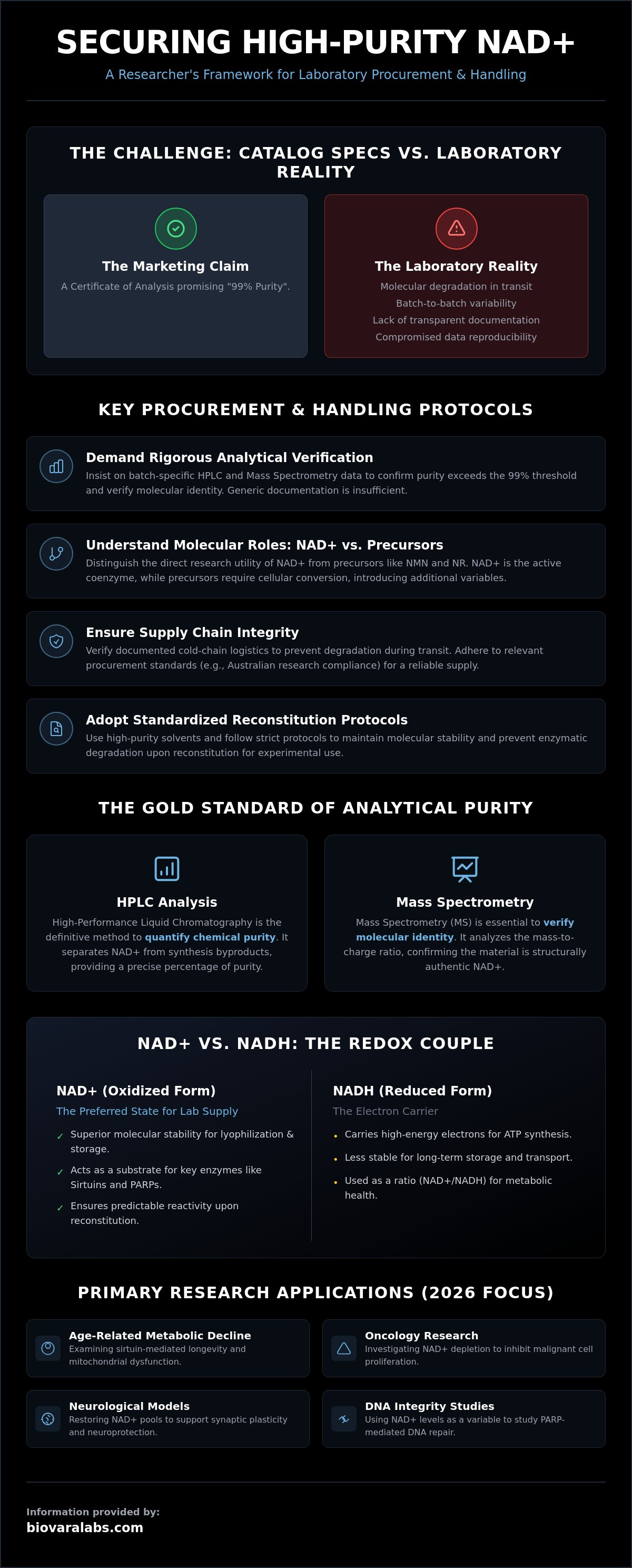
High-purity Nicotinamide Adenine Dinucleotide (NAD+) serves as a cornerstone for cellular bioenergetics research, yet the gap between catalog specifications and laboratory reality remains a significant hurdle for investigators. A Certificate of Analysis claiming 99% purity is functionally irrelevant if the molecular integrity of the coenzyme degrades during transit or improper reconstitution. Securing a consistent NAD+ peptide laboratory supply requires a rigorous approach to procurement that prioritizes analytical transparency over generic marketing claims.
You're likely aware that batch-to-batch variability and a lack of transparent HPLC or Mass Spec documentation can compromise the reproducibility of your sensitive data. This technical reference provides a definitive framework for procuring high-purity materials while establishing standardized protocols for laboratory storage and handling. We'll analyze the current 2026 benchmarks for analytical verification, molecular stability under cold-chain logistics, and the specific compliance standards required for Australian research environments. By focusing on documented stability and verified chemical states, researchers can ensure their materials meet the exacting requirements of modern scientific inquiry.
Key Takeaways
- Implement rigorous analytical verification using HPLC and Mass Spectrometry to ensure batch-specific purity exceeds the 99% threshold.
- Distinguish the specific research utility of direct NAD+ from precursors like NMN and NR to optimize experimental outcomes in cellular bioenergetics.
- Secure a reliable NAD+ peptide laboratory supply by adhering to Australian procurement standards and documented cold-chain logistics.
- Adopt standardized reconstitution protocols using high-purity solvents to maintain molecular stability and prevent enzymatic degradation.
- Evaluate the synergistic properties of high-purity NAD+ within specialized research stacks designed for mitochondrial and cellular investigation.
Defining NAD+ in a Laboratory Context: The Molecular Mechanism
Nicotinamide adenine dinucleotide (NAD+), identified by CAS 53-84-9, represents a critical dinucleotide coenzyme essential for all living cells. It consists of two nucleotides joined through their phosphate groups, featuring a nicotinamide moiety and an adenine moiety. Within the mitochondrial electron transport chain, it functions as a primary electron carrier, facilitating the synthesis of adenosine triphosphate (ATP) through oxidative phosphorylation. In the context of a high-tier NAD+ peptide laboratory supply, researchers prioritize the oxidized state of the molecule, which acts as a requisite substrate for enzymes regulating cellular survival and genomic integrity.
The metabolic utility of NAD+ extends far beyond simple redox reactions. It's a necessary co-substrate for sirtuins (SIRT1-7), a family of protein deacetylases that govern metabolic homeostasis, mitochondrial biogenesis, and stress resistance. Specifically, SIRT1 and SIRT3 activation depends on high intracellular NAD+ levels to modulate nuclear and mitochondrial gene expression. Additionally, poly(ADP-ribose) polymerases (PARPs) rely on NAD+ concentrations to facilitate complex DNA repair mechanisms. In many cellular ageing models, NAD+ availability becomes the limiting factor for PARP activity; this depletion leads to accumulated genomic instability and diminished mitochondrial function, making the consistency of NAD+ peptide laboratory supply a vital variable in longitudinal studies.
NAD+ vs. NADH: Understanding the Redox Couple
The NAD+/NADH ratio serves as a primary metric for quantifying metabolic health and glycolytic flux in research models. While NADH acts as the reduced form carrying high-energy electrons, the oxidized form (NAD+) is the preferred state for laboratory procurement due to its superior molecular stability during lyophilization and long-term storage. Laboratory-grade supply focuses on maintaining the oxidized state to ensure predictable reactivity upon reconstitution. The redox potential of the NAD+/NADH couple dictates the thermodynamic efficiency of mitochondrial electron transfer and the resultant yield of cellular ATP.
Primary Research Applications in 2026
Current research trajectories emphasize the role of NAD+ in mitigating physiological decline through several specialized avenues:
- Age-Related Metabolic Decline: Investigators utilize high-purity NAD+ to examine sirtuin-mediated longevity pathways and the potential reversal of mitochondrial dysfunction in senescent cells.
- Oncology Research: Research explores NAD+ depletion as a metabolic strategy to inhibit the rapid proliferation of malignant cells. By targeting the NAMPT-mediated salvage pathway, scientists aim to starve tumors of essential glycolytic cofactors.
- Neurological Models: Studies focus on energy metabolism within neurons, targeting cognitive decline through the restoration of NAD+ pools to support synaptic plasticity and neuroprotection in neurodegenerative environments.
- DNA Integrity Studies: Research focuses on the rate of PARP-mediated repair in response to oxidative stress, using NAD+ concentrations as a primary experimental variable.
Analytical Purity Standards for NAD+ Peptide Supply
High-Performance Liquid Chromatography (HPLC) remains the definitive methodology for assessing the chemical purity of a NAD+ peptide laboratory supply. This analytical technique separates the target molecule from potential synthesis byproducts based on their varying affinities for a stationary phase. While HPLC provides a quantitative measure of purity, Mass Spectrometry (MS) is required to verify molecular weight and structural identity through precise mass-to-charge ratio analysis. Together, these methods ensure that the material received by investigators matches the theoretical molecular profile of Nicotinamide Adenine Dinucleotide. Relying on generic documentation is insufficient for high-stakes research. Investigators must demand batch-specific Certificates of Analysis (CoA) that reflect the specific lot being procured rather than a historical average.
Quality control protocols must also identify residual contaminants that could interfere with cellular assays. Common impurities found in lower-tier supplies include:
- Trifluoroacetic acid (TFA): A common counter-ion used during synthesis that can exert cytotoxic effects in sensitive cell cultures.
- Residual organic solvents: Compounds such as acetonitrile or methanol that must be removed through secondary purification steps.
- Moisture content: Excessive water in lyophilized powders that can accelerate hydrolytic degradation.
A thorough understanding of NAD+ metabolism and cellular roles underscores why even trace impurities can skew data in mitochondrial studies. Contaminants can act as unintended enzyme inhibitors or alter the pH of the reconstitution medium, leading to artifacts in experimental results.
Interpreting HPLC Chromatograms for NAD+
Chromatographic data should display a single, sharp peak with minimal baseline noise to confirm reagent-grade quality. High peak resolution indicates the absence of closely related structural analogues or degradation products that could compromise experimental integrity. Symmetrical peaks at the correct retention time are fundamental for ensuring reproducibility across different laboratory environments. When evaluating research peptides Australia, investigators look for baseline-to-baseline purity metrics that exceed 99% to minimize biochemical interference.
The Role of Lyophilization in Peptide Integrity
Lyophilization, or freeze-drying, is the preferred method for stabilizing NAD+ into a solid state for transport and storage. This process removes water through sublimation under vacuum, which prevents the hydrolytic degradation common in liquid formulations. Lyophilized powders offer significantly better long-term stability when stored at -20°C or -80°C. Maintaining moisture levels below 5% is essential for research peptides to prevent spontaneous degradation and maintain molecular integrity over time. For researchers requiring materials that meet these exacting standards, Biovara Labs provides analytical grade NAD+ verified through rigorous mass spectrometry and HPLC testing.
NAD+ vs. Precursors: Comparative Stability and Research Utility
The molecular architecture of Nicotinamide Adenine Dinucleotide (NAD+) presents a higher degree of structural complexity compared to its primary precursors, Nicotinamide Mononucleotide (NMN) and Nicotinamide Riboside (NR). NAD+ possesses a molecular weight of approximately 663.4 g/mol, which is nearly double that of NMN (~334.2 g/mol). This increased complexity necessitates more stringent analytical oversight when evaluating a NAD+ peptide laboratory supply, as the dinucleotide structure is inherently more susceptible to hydrolytic cleavage of the pyrophosphate bond. While precursors are often selected for their relative stability in ambient conditions, direct NAD+ remains the gold standard for investigators requiring immediate coenzyme availability without reliance on endogenous biosynthetic machinery.
Stability profiles for NAD+ demand precise temperature regulation, typically requiring storage at -20°C or -80°C in anhydrous environments. Precursors like NR may exhibit greater resilience at 4°C, yet the cost-to-yield analysis for large-scale laboratory investigations often favors direct NAD+ application when the research objective involves bypassing metabolic bottlenecks. The thermal sensitivity of NAD+ requires a documented cold-chain for procurement to prevent the accumulation of degradation products like nicotinamide and ADP-ribose, which can act as unintended inhibitors in sirtuin assays.
NMN and NR: The Enzymatic Pathway
The conversion of NMN to NAD+ is mediated by the enzyme nicotinamide phosphoribosyltransferase (NAMPT), which frequently acts as a rate-limiting bottleneck in cellular ageing models. Researchers utilize direct NAD+ to circumvent this enzymatic dependency, allowing for precise control over intracellular coenzyme pools. Chemical purity standards for NMN (CAS 1094-61-7) and NR (CAS 1341-23-7) often mirror those of NAD+, yet the biological utility differs significantly in models where NAMPT expression is compromised or where immediate mitochondrial uptake is required.
Direct NAD+ Application in Preclinical Models
Standardizing concentrations in cell culture requires careful consideration of the degradation rates observed in aqueous buffers like PBS or DMEM. In vitro, NAD+ exhibits a half-life that varies based on pH and temperature, necessitating fresh reconstitution for each experimental iteration to ensure data validity. Much like the precision required for handling laboratory grade Semaglutide and other high-purity analogs, NAD+ must be handled with strict aseptic technique. Maintaining a high-quality NAD+ peptide laboratory supply involves verifying that the material remains in its oxidized state throughout the experimental timeline to avoid the confounding effects of spontaneous reduction.
Laboratory Procurement and Storage Protocols
Procuring high-tier reagents within the Australian research ecosystem demands more than simple transactional fulfillment. It requires a documented chain of custody and strict adherence to thermal stabilization protocols. For long-term preservation, lyophilized NAD+ must be maintained at -20°C in a manual-defrost freezer to avoid the temperature spikes characteristic of auto-defrost cycles. Short-term storage at 4°C is acceptable for periods not exceeding 72 hours, provided the material is protected from light and moisture. To maximize the longevity of your NAD+ peptide laboratory supply, investigators should aliquot the reagent into single-use volumes immediately after the initial reconstitution. This strategy eliminates the molecular stress associated with repeated freeze-thaw cycles; these cycles can induce structural cleavage and diminish experimental potency.
Reconstitution and Handling Standards
Precision in experimental dosing begins with accurate molarity calculations based on the batch-specific mass provided in the CoA. When preparing the stock solution, the choice of solvent is paramount for maintaining sterility and stability. While sterile saline is suitable for immediate application, the use of bacteriostatic water is recommended for multi-use vials to inhibit microbial proliferation over the course of an experimental series. A properly reconstituted NAD+ solution should appear as a clear, colorless liquid free from visible particulates or opalescence. Any deviation from this visual standard, such as cloudiness or precipitation, indicates potential contamination or advanced degradation of the coenzyme.
Shipping and Transit Safeguards in Australia
Australia's diverse climate zones present unique challenges for the transit of sensitive biochemicals. Heat exposure during national shipping can rapidly compromise the integrity of unshielded peptides. Meticulous suppliers utilize vacuum sealing and high-grade desiccant packs to protect the lyophilized powder from atmospheric moisture and oxidation. These safeguards, combined with rapid domestic logistics, ensure that the NAD+ peptide laboratory supply arrives in a state that meets Australian laboratory standards for non-human research chemicals. It's essential to verify that your provider implements these protective measures to ensure the validity of your baseline data. For researchers seeking materials that adhere to these exacting standards, Biovara Labs offers high-purity NAD+ with verified stability profiles and domestic shipping safeguards.
Biovara Labs: High-Purity NAD+ Supply for Scientific Study
Biovara Labs functions as a specialized resource for investigators requiring high-tier biochemicals that exceed standard commercial benchmarks. Our primary focus remains the delivery of analytical-grade compounds that meet the exacting requirements of modern mitochondrial and longevity research. This dedication to precision ensures that every NAD+ peptide laboratory supply procurement aligns with the rigorous standards of professional scientific inquiry. Beyond individual reagents, we provide specialized configurations such as the Glow Stack; this offering facilitates the study of synergistic cellular pathways through the combination of high-purity NAD+ and complementary research peptides.
The availability of essential reagents is critical for maintaining experimental continuity. Our inventory extends to necessary accessories such as Bacteriostatic Water, ensuring that researchers have access to high-purity solvents for precise reconstitution. Additionally, we provide specialized compounds like MOTS-c 10mg, supporting a broad spectrum of metabolic and bioenergetic studies. By positioning ourselves as a meticulous provider rather than a traditional retailer, we prioritize the integrity of the scientific process through the delivery of verified chemical states.
The Biovara Analytical Advantage
Analytical precision is the foundation of our manufacturing process. Every production lot undergoes comprehensive High-Performance Liquid Chromatography (HPLC) and Mass Spectrometry (MS) testing to verify chemical identity and purity levels. We prioritize transparency by providing batch-specific Certificates of Analysis (CoA) to both institutional and independent researchers. This rigorous verification process eliminates the uncertainty of batch-to-batch variability, allowing scientists to focus on data acquisition rather than reagent validation. Our commitment to the advancement of scientific discovery is reflected in the meticulous standards applied to all mitochondrial research tools.
Procurement Logistics for 2026
The 2026 procurement framework at Biovara Labs emphasizes accessibility and technical reliability within the Australian research landscape. Our localized logistics infrastructure ensures that every NAD+ peptide laboratory supply order is handled with the necessary safeguards to maintain molecular integrity during transit. Ordering systems are optimized for research facilities, offering clear specifications and technical data for diverse experimental scales. Technical support is available to assist researchers with specific inquiries regarding peptide specifications, handling protocols, and molecular stability metrics. Secure HPLC-verified NAD+ for your laboratory research at Biovara Labs.
Advancing Mitochondrial Research Through Analytical Precision
Standardizing the procurement of high-purity reagents is a fundamental requirement for the reproducibility of modern cellular studies. Researchers must move beyond generic catalog descriptions and prioritize materials verified through batch-specific HPLC and Mass Spectrometry. Establishing a reliable NAD+ peptide laboratory supply involves not only securing 99% purity but also implementing rigorous storage and reconstitution protocols to maintain molecular stability. By utilizing specialized configurations like the Glow Stack and adhering to documented cold-chain logistics, investigators ensure their experimental baselines remain untainted by hydrolytic degradation or synthesis byproducts.
Biovara Labs remains committed to supporting the Australian scientific community with clinical-grade materials and expert domestic shipping. We provide the technical transparency and analytical rigor required for both institutional and independent discovery. Our focus is the advancement of scientific understanding through meticulous manufacturing and reliable supply chains. Explore our high-purity NAD+ research compounds and laboratory supplies. We look forward to facilitating your next breakthrough in cellular bioenergetics.
Frequently Asked Questions
What is the purity standard for NAD+ peptide laboratory supply?
The analytical purity standard for a professional NAD+ peptide laboratory supply is a minimum of 99% as verified by High-Performance Liquid Chromatography (HPLC). This threshold ensures that experimental artifacts are minimized and that the coenzyme's reactivity remains predictable across various cellular assays. Purity levels below this benchmark often indicate the presence of synthesis byproducts or degradation contaminants like nicotinamide, which can compromise the validity of mitochondrial research data.
How should lyophilized NAD+ be stored in a laboratory setting?
Lyophilized NAD+ must be stored at -20°C in a manual-defrost freezer to maintain long-term molecular integrity. For short-term experimental use not exceeding 72 hours, storage at 4°C is acceptable provided the material is shielded from light and atmospheric moisture. Researchers should implement an aliquoting strategy immediately after the initial reconstitution to prevent the structural cleavage associated with repeated freeze-thaw cycles, which rapidly diminishes the coenzyme's potency.
Is NAD+ from Biovara Labs intended for human consumption?
No, NAD+ supplied by Biovara Labs is strictly designated for in-vitro laboratory research only and isn't intended for human or veterinary consumption. This material is an analytical grade reagent designed for use in controlled experimental environments. Compliance with this designation is a critical legal and ethical requirement for researchers, as the compound hasn't been approved for clinical use as a finished drug product.
What is the difference between NAD+ and NMN in research models?
The primary difference lies in the molecular hierarchy; NAD+ is the active coenzyme, while NMN is a precursor that requires enzymatic conversion via NAMPT. In research models, direct NAD+ application bypasses the rate-limiting bottlenecks associated with endogenous biosynthesis. This allows investigators to observe the immediate effects of coenzyme availability on sirtuin activation and mitochondrial bioenergetics without the confounding variables of precursor metabolism or enzymatic efficiency.
How do I reconstitute NAD+ for in-vitro study?
Reconstitution should be performed using Bacteriostatic Water or sterile saline under strict aseptic conditions. The choice of solvent depends on the duration of the study; Bacteriostatic Water is preferred for multi-use vials to prevent microbial proliferation. Once the solvent's added, the vial should be gently swirled rather than shaken to ensure a clear, colorless solution, as vigorous agitation can induce mechanical stress on the dinucleotide structure.
Does Biovara Labs provide a Certificate of Analysis (CoA) for NAD+?
Biovara Labs provides a batch-specific Certificate of Analysis (CoA) for every NAD+ peptide laboratory supply order. This documentation includes both HPLC chromatograms for purity verification and Mass Spectrometry data for molecular weight confirmation. Access to these analytical metrics allows institutional and independent researchers to verify the chemical identity and state of the material before commencing sensitive longitudinal or preclinical investigations.
What are the shipping times for NAD+ research peptides in Australia?
Domestic shipping for NAD+ research peptides within Australia is managed through expedited logistics to mitigate thermal exposure. While transit times vary based on the specific climate zone and laboratory location, all orders are processed with strict quality safeguards, including vacuum sealing and desiccant packs. This organization ensures that the lyophilized material remains stable and protected from atmospheric degradation throughout the national transit process.
Can NAD+ be used in synergistic research stacks like the Glow Stack?
High-purity NAD+ is frequently utilized in synergistic research stacks, such as the Glow Stack, to investigate complex cellular interactions. These configurations allow researchers to study the combined effects of the coenzyme with other research peptides like MOTS-c or BPC-157. Utilizing standardized stacks facilitates the exploration of mitochondrial biogenesis and tissue repair mechanisms within a controlled, multi-variable experimental framework designed for advanced scientific discovery.


